
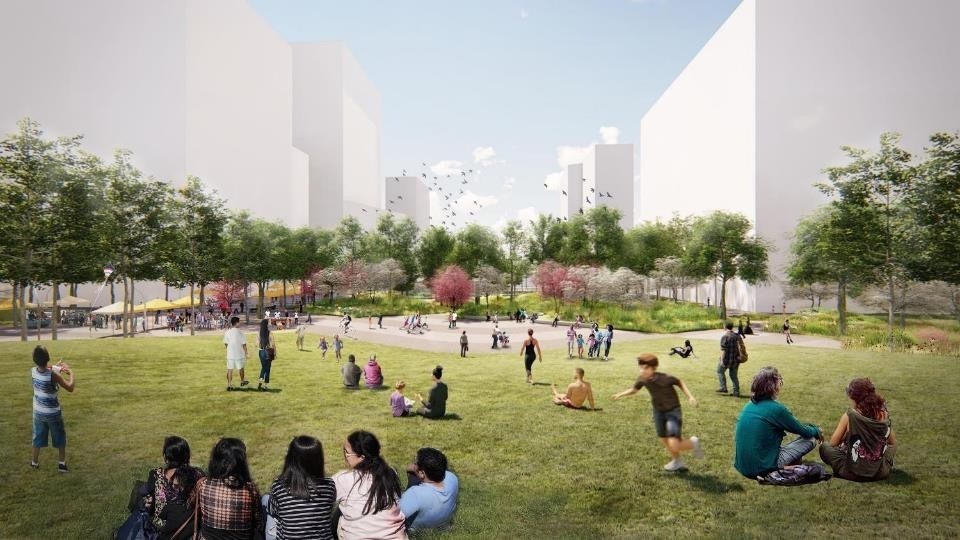
Bronzeville Lakefront, an upcoming 100-acre, $8.2 billion mega-development on Chicago’s South Side, aims to set new standards locally and nationally for sustainability, inclusion, economic impact and healthy living, according to Grit, a joint venture between Farpoint Development, Bronzeville Community Development Partnership, Chicago Neighborhood Initiatives, Draper & Kramer, Loop Capital and McLaurin Development, that is creating the development
To do so, the Grit development team engaged three strategic consultants: MacArthur “Genius Grant” recipient landscape architect Walter Hood; regenerative design architect Jason McLennan and urban innovation company Sidewalk Labs.
Bronzeville Lakefront takes its name from the surrounding neighborhood of Bronzeville, which has been nationally known as a thriving hub for Black arts, culture and entrepreneurship for a century. But the area has suffered disinvestment and population loss in recent decades. For 128 years, this lakefront site held the Michael Reese Medical Center, a paragon of healthcare innovation and equity in its heyday.
To honor the site’s significant legacy and ensure the development will spur economic growth and attract diverse residents and businesses, Bronzeville Lakefront will feature a broad mix of housing, dining options, offices, wet lab spaces and nine acres of sustainable green space for recreational use. Its anchor, the Bronzeville Innovation Center, will include community spaces and be powered by the Chicago ARC, a life sciences accelerator developed in partnership with Israel’s Sheba Medical Center.
“With specializations in environmental design, community development and citizen engagement, Walter Hood brings a holistic perspective honed by decades of experience and achievement to the project,” said Grit Partner and Farpoint Development Principal Regina Stilp. “He’ll help us leverage the native ecology of the site itself, capitalize on local community assets and implement inclusive placemaking to create the most effective ecosystem possible at Bronzeville Lakefront.”
Hood is known for his rare ability to anticipate elements communities want and need and integrate them into the public spaces he creates. In 2019, the MacArthur Foundation named him as a fellow (known as the Genius Grant) for “creating ecologically sustainable urban spaces that resonate with, and enrich the lives of, current residents while also honoring communal histories.” Hood was also chosen as the first Robert R. Taylor Fellow at MIT for his “pioneering work in environmental design, particularly in the integration of history, race and urban design,” and projects that “stand out for their sustained engagement with diverse local communities.”
Jason McLennan, who has pushed the boundaries on what is possible in the built environment with his Living Building Challenge, believes these approaches not only impact real communities and real lives for the better but are also critical to embrace now given issues surrounding sustainability, environmental justice and climate change.
“When Jason introduced the Living Building Challenge, the design and construction industry rejected it as too stringent, too hard, too expensive and too out there,” Stilp said. “But Jason is skilled and effective at fighting uphill battles and today there are Living Buildings all over the world. We’re calling on him to help us carry this progressive paradigm forward not only in multiple individual structures but on a district-wide scale at Bronzeville Lakefront to create a regenerative and stable environment that also promotes health and wellness.”
In 2012, he was named an Ashoka Fellow for creating new practices in the built environment to improve health and well-being while increasing access to a diverse and productive natural world and also received the Buckminster Fuller Challenge, the world’s top prize for socially responsible design, for the Living Building Challenge.
“Sustainability is key to the economic impact and environmental justice we hope to achieve at Bronzeville Lakefront. It’s critical to maximize our natural resources, and that requires state-of- the-art infrastructure systems that can adapt to the community’s changing needs,” Stilp explained. “Sidewalk Labs has developed technological solutions we can use to design and build the most resilient and effective systems possible with respect to energy, water, mobility and waste.”
Many of the solutions and strategies Sidewalk Labs, which has been absorbed by Google since being engaged by Grit, conceived of or recommended are emergent. They will support the creation of a more sustainable and resilient energy system that will tap into clean thermal solutions and microgrids, minimize stormwater runoff and maximize recycling efforts from all water sources on the land, analyze all the development’s road and public transit usage to create efficiencies and upcycle the development’s waste materials into new products.