
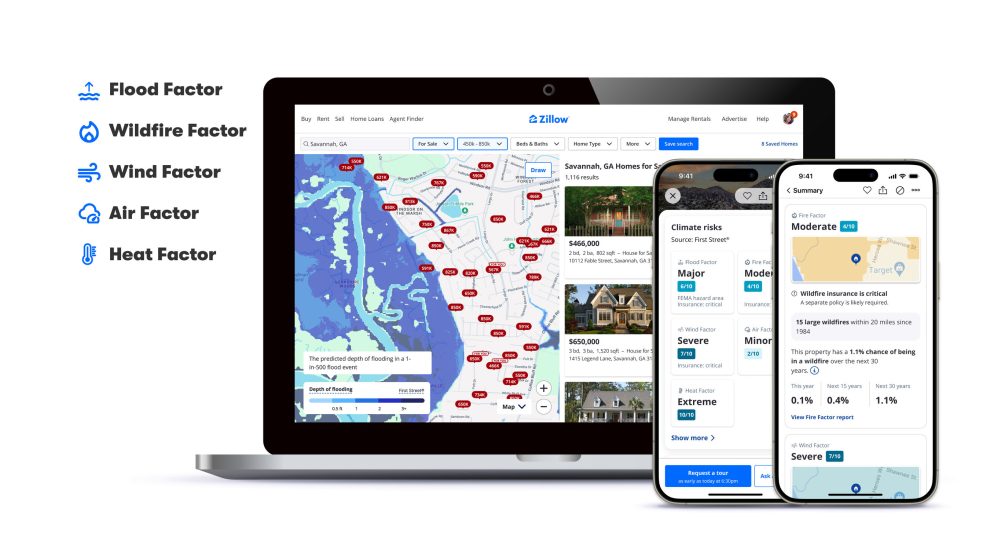
Zillow is introducing climate risk data, provided by First Street, a provider of climate risk financial modeling, on for-sale property listings across the U.S. Home shoppers will gain insights into five key risks — flood, wildfire, wind, heat and air quality — directly from listing pages, complete with risk scores, interactive maps and insurance requirements.
Each risk is color-coded and has its own color scale, helping consumers intuitively navigate their search. Informative labels give more context to climate data and link to First Street’s property-specific climate risk reports for full insights.
With more than 80% of buyers now considering climate risks when purchasing a home, according to Zillow research, this feature provides a clearer understanding of potential hazards, helping buyers to better assess long-term affordability and plan for the future. In assisting buyers to navigate the growing risk of climate change, Zillow is the only platform to feature tailored insurance recommendations alongside detailed historical insights, showing if or when a property has experienced past climate events, such as flooding or wildfires.
“Climate risks are now a critical factor in home-buying decisions,” said Skylar Olsen, chief economist at Zillow. “Healthy markets are ones where buyers and sellers have access to all relevant data for their decisions. As concerns about flooding, extreme temperatures and wildfires grow — and what that might mean for future insurance costs — this tool also helps agents inform their clients in discussing climate risk, insurance and long-term affordability.”
First Street’s models, developed by scientists and vetted through a peer-review process, are used across multiple industries, including real estate, banking, government and insurance, ensuring that the climate insights given on Zillow are both credible and actionable.
“At First Street we are on a mission to connect climate change to financial risk,” said Matthew Eby, founder and CEO of First Street. “Partnering with Zillow helps us achieve that mission by providing the millions of everyday users on the Zillow platforms with the same property-specific climate risk data that is used by top banks, agencies and investors.”
Climate risk information will be available on the Zillow app for iOS and on the Zillow website by the end of the year, with Android availability expected early next year.