
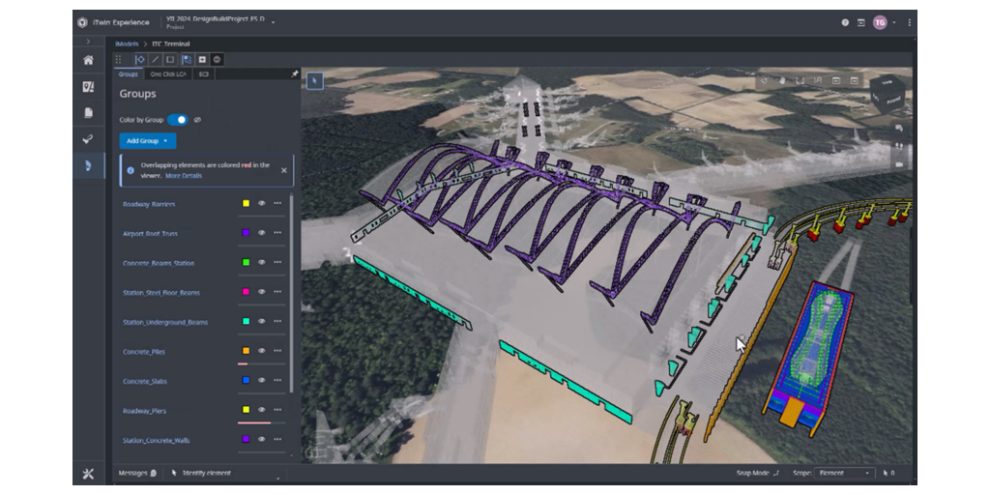
Infrastructure engineering software company Bentley Systems Incorporated announced the general availability of new Carbon Analysis capabilities in iTwin Experience to assess and reduce carbon impacts for more sustainable infrastructure. The new carbon analysis capabilities enable infrastructure engineers to simplify carbon reporting, easily visualize embodied carbon, and rapidly explore alternatives for better designs.
Embodied carbon is the carbon footprint of an asset before it is built, encompassing the greenhouse gases emitted during the construction process. Bentley’s new Carbon Analysis capabilities deliver a “cradle-to-gate” assessment of a design’s carbon footprint, from raw material extraction until it leaves the factory’s gate, which represent the largest contributors to embodied carbon.
“Between now and 2050, embodied carbon linked to new infrastructure is projected to be responsible for half of the world’s carbon footprint release, even before the infrastructure is used,” said Savina Carluccio, executive director, International Coalition for Sustainable Infrastructure (ICSI). “Given its significant contribution to global emissions, the sector must act with urgency to reduce embodied carbon at scale, as part of wider decarbonization and climate action efforts — from leveraging a highly connected and collaborative value chain to using new digital technologies that enable the selection and use of alternative, carbon-efficient materials in sustainable infrastructure designs.”
Bentley’s new Carbon Analysis capabilities integrate a user’s design data with their chosen carbon assessment tool. This enables infrastructure professionals to link carbon footprints directly to their design choices and see those impacts dynamically change across design iterations.
“Carbon assessments should be standard practice for global infrastructure projects, but creating carbon reports isn’t easy,” said Chris Bradshaw, chief sustainability officer, Bentley Systems. “Using Bentley’s new Carbon Analysis capabilities helps transform the tedious task of carbon reporting into a smooth, automated process — providing infrastructure professionals with greater visibility into carbon impacts and helping them design sustainable infrastructure faster and more easily.”
Traditionally, producing a carbon analysis report is highly manual, time consuming and costly, with multiple steps: organizing siloed data, translating the data into carbon metrics and producing a final report. The process becomes even more difficult for large, complex infrastructure projects, which typically involve diverse stakeholders, datasets, data formats, and construction materials.
Bentley’s new Carbon Analysis capabilities help overcome these challenges through automated material quantification that ingests and aggregates project and asset data, files and models — created from Bentley software and other sources — into a digital twin, for a single, simplified view. A single click generates a cradle-to-gate embodied carbon accounting in minutes through integration with a user’s chosen carbon assessment calculator. Since all data is dynamically stored, users can adjust material selections through the lifetime of a design, creating an easy, repeatable process. It also allows users to explore sustainable design and material alternatives in minutes to create higher-quality designs throughout the design and construction phase.
The Carbon Analysis capabilities are available immediately to iTwin Experience users at no additional cost. An additional license to a carbon assessment calculator (e.g., EC3 or OneClickLCA) is required, which can be obtained by users from those vendors directly.
Example of Bentley’s Carbon Analysis capabilities: Embodied carbon grouping of common components for reporting. (Photo: Bentley Systems)