
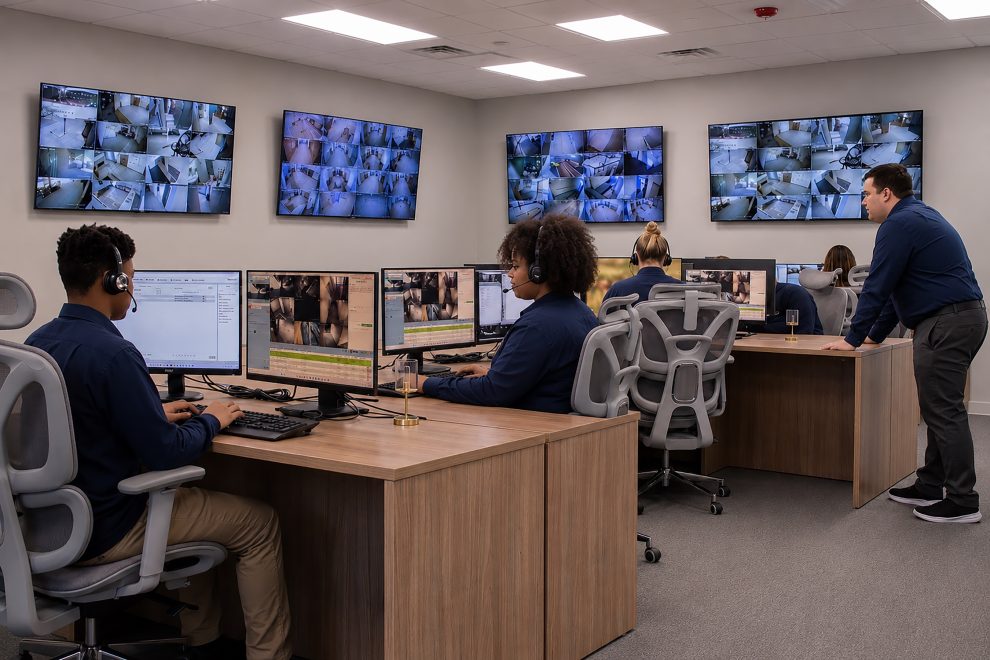
Virtual Service marks its 30th anniversary—celebrating its role defining an industry and creating an operational system that merges cutting edge technology and innovation with human connection.
Virtual Doorman set the industry standard for multifamily (cooperatives, condominiums, apartment buildings) and private residence building security, access and management without losing the human touch. Its clients include multifamily portfolios and residential communities for tens of thousands of residents across the states of New York, New Jersey, Connecticut, California, Florida, Illinois, Indiana, Maryland, Pennsylvania and Virginia. Virtual Service has a client retention rate consistently in the high ninety-percent range and long-standing partnerships spanning decades.
Colin Foster, founder and chief innovation officer of Virtual Service, brought a major differentiating perspective to the security monitoring industry. With the launch of Virtual Doorman, he was uniquely able to apply his expertise in interactive video to the security monitoring industry—and taking it many steps further. He addressed a fundamental gap in residential buildings: secure building access and resident support without the need for an onsite doorman. The mission, then and now, is to make residential buildings safer, smarter and more efficient—without losing the human connection that defines compassionate, great service and builds trust.
Virtual Doorman does not just dispatch alarms to the authorities, they use live 2-way video, as if they were actually onsite, to assess the situation: accepting packages and deliveries, granting access remotely for residents and guests and responding accordingly—it truly is technology for easy living.
In 1997, when Virtual Doorman was introduced, there was no scalable solution between basic intercom systems and full-time doorman staffing. By combining technology with live, remote operators, Virtual Doorman became the trailblazer of virtual concierge and remote access control systems establishing a new approach to building access—defined by real-time verification, accountability, operational consistency and human touch.
Foster stated, “We set out to find a way to enable buildings to offer the same services as a traditional doorman—but at a fraction of the cost—one that was less intrusive yet consistent and dependable. Our residents have great peace of mind knowing that there is a person they can connect with 24 hours a day, not just an email or text—and building management knows everything is under control.”
Developing the earliest prototypes by hand, Foster installed test units in neighborhood buildings and perfected the system through trial and error. Long before cloud computing or remote monitoring was mainstream, Virtual Doorman developed a fully functioning offsite operations center. As the category of proptech increasingly shifts toward AI, Virtual Doorman continues to emphasize a hybrid approach—combining technology with human oversight to deliver consistent, accountable outcomes in real-world conditions.
Matthew Barnes, executive vice president, explained, “At the start, Virtual Doorman set out to solve a known daily problem and we created a product everyone entering the category has emulated, but has never been able to replicate, or surpass—it is based on our focus on human connection and technological leadership.”
Rather than positioning the milestone as a retrospective, Virtual Service is using its 30th anniversary to reinforce its role as a category leader. Not just the provider of Virtual Doorman but a platform capable of supporting multiple building operations solutions through integrated technology and live oversight. Residents feel secure, buildings operate smoothly and owners have confidence in how access is being managed.
“At this juncture, we are most proud not of a single moment but rather the consistency of execution over time,” Foster explained. “We’ve spent decades refining a system that people rely on every day, without thinking about it—we are trusted. We built and operate a model/system that continues to shape the industry.”
Over the past three decades, Virtual Doorman has been refined through millions of real-world interactions, shaping standardized protocols, training systems and operational processes. By tracking emerging technologies and always looking to the future, Virtual Doorman retains its competitive edge in an industry they jumpstarted in 1997.