
 Jason Rupp, partner at AO Architects
Confronted with the ever-increasing cost of land and construction, multifamily developers are continuously seeking ways to maximize design efficiency for their high-density urban projects. A key focus to date has been construction technology innovations, like modular and mass timber, that can significantly speed up construction timelines and lower project costs.
Often overlooked, advancements in parking structure optimization can add significant value to multifamily projects for residents and developers. By understanding the technologies, regulations and opportunities presented, developers can leverage parking structure design to optimize multifamily projects.
Leveraging Wrap Buildings
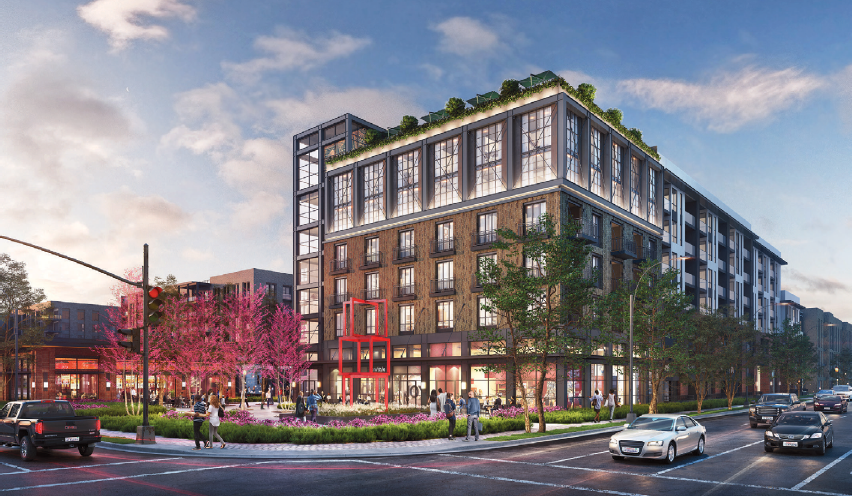
In land-constrained urban areas, where the cost of land is too prohibitive to allow for surface parking but not prohibitive enough to justify the cost of structured parking, many developers are opting to build “wrap” structures, also known as “Texas donuts.” These allow for high density and curb appeal, while mitigating the construction cost of parking. This building type typically consists of a mid-rise residential building surrounding or “wrapping” around an above-grade concrete parking structure. Recently, architects have started pushing the envelope on the design of wrap structures by relocating elements typically found in residential buildings, such as maintenance and storage areas, trash rooms and even pet spas, to the adjacent parking structure. This frees up space to maximize the leasable area of the residential structure.
What’s more, architects and developers are leveraging the parking structure’s rooftop to create attractive, amenity-filled roof decks for their Class-A communities. This trend has led to the reinvention of the amenity deck and an upgraded level of service that delivers on the “wow” factor, piquing the interest of prospective tenants. As an added bonus, elevating amenities helps address a current pitfall of wrap buildings, where communal areas and amenities, such as swimming pools and barbecues, are traditionally located in cavernous inner courtyards cloistered by four walls, shaded from the sun. By moving these amenities to the rooftop, developers are able to create a true resort lifestyle for residents who can enjoy year-round optimal sun exposure and unobstructed views of the cityscape.
The George, a 340-unit luxury community by developer Lyons Living in Anaheim, California, is a great example of this trend. The centerpiece of the wrap community is a jaw-dropping 32,000-square-foot rooftop deck which spans the entire roof surface of the parking structure. The expansive space features a full-service beer garden, an indoor-outdoor fitness complex with yoga room, two pools and oversized spa, clubroom, vivid murals, a jumbotron, a terraced rooftop garden and 360-degree city lights views, which can include Disneyland fireworks.
There are several key considerations for developers seeking to move communal amenities atop a parking structure, including location and cost. Unless land is extremely cost-prohibitive, it is typically less expensive to install an inground pool than building out a robust structural system that can withstand the full weight of a rooftop pool. With that said, if developers are considering a rooftop pool, it is easier and more cost-effective to put a pool on top of a parking structure compared to a residential building.
Another key consideration is building code compliance and, more specifically, how to ensure that people can evacuate safely in case of an emergency. To comply, amenity decks are equipped with elevators that can function on emergency power and oversized stairways with safe, easy access that can amply accommodate the rooftop’s maximum occupancy.
Limitations for Multifamily
Car stackers are gaining traction in urban areas, such as downtown cores of major cities, where land is limited and reaching sky-high prices. Many infill multifamily projects are turning to this new technology to meet cities’ parking quotas while minimizing the space dedicated to parking. Although there are many benefits to leveraging car stackers for certain projects, not all multifamily projects lend themselves to this new technology. First, car stackers are rarely cost-effective, with the installation of bays and automated technology being significantly more costly and usually prolongating construction timelines.
In addition, car stackers have traditionally been ill-suited for larger multifamily complexes, as most residents tend to follow the same work schedule and need to retrieve and park their cars at similar hours. This can create a major logistical hurdle in communities with hundreds of residents. However, this key issue might somewhat be mitigated in the aftermath of the coronavirus pandemic, as two in five American employees are expected to keep working either fully or partially remotely in the near future, according to a recent report by Willis Towers Watson. This, in turn, might affect the current peak traffic model and bring new opportunities for this type of technology. In the current landscape, however, car stackers are better suited for smaller multifamily projects, for transit-oriented developments in downtown areas, where residents primarily use parking to store their cars for occasional outings, or for retail centers where shoppers come and go at different hours of the day.
Future-Proofing for Electrical Vehicles
While the mainstream adoption of EV has been quite slow, with EV penetration at 2.8% in 2020, federal, state and local governments are making a push to accelerate the move to EV. President Biden’s proposed $2 trillion infrastructure plan encompasses a $174-billion investment to incentivize individuals and businesses to make the switch to EV through various tax credits, rebates and other incentives and by creating a robust network of charging stations by 2030. Around the nation, many large cities have already instated quotas for EV parking stalls and charging stations in new multifamily developments. In California, Governor Gavin Newsom recently signed an executive order requiring that by 2035, all new cars and passenger trucks sold in California be zero-emission vehicles.
In California specifically, the 10% EV stall requirements in ground-up multifamily developments have been particularly confusing, with cities and states issuing conflicting regulations. Until recently, EV charging stalls did not count toward the minimum zoning parking requirements, and neither did the mandated EV-accessible parking stalls or accompanying loading/unloading aisles. This required developers to account for significantly increased parking in new multifamily developments, an added cost resulting in less rentable space. Realizing that these stringent regulations were actually penalizing developers trying to include more EV stalls, the state adopted AB-1100 in October 2019, which now counts both EV stalls, accessible EV stalls and access aisles as part of the applicable minimum parking requirements. This new regulation now supersedes all individual city requirements, many of which have not yet caught on to the new AB-1100 mandates.
Since the 1930s, the advent of mass-produced cars has had a tremendous impact on our lifestyle. Today, we are seeing real cultural shifts that will reshape our need for parking in years to come, including the emergence of ridesharing, EV and autonomous vehicles and even the recent acceleration of the transition to remote work due to the COVID-19 pandemic. While it is hard to predict how much this shift in the transportation paradigm will affect future need for parking spaces, it is important for developers to keep a finger on the pulse of these latest developments so that they can optimize the design of their multifamily projects to meet the needs of residents both today and tomorrow.
Jason Rupp is a partner at AO Architects. He began his career in structured parking in 1988 and has been involved in every aspect of parking design across all types of real estate.