
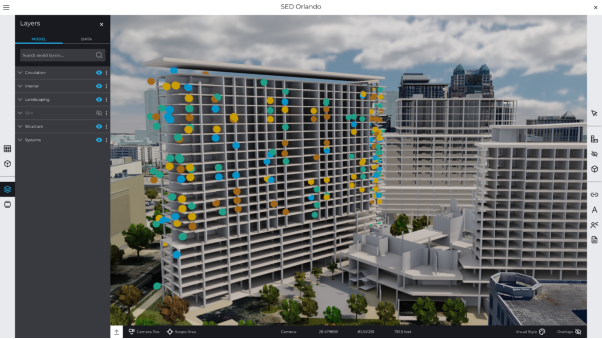
The cost benefits of digital twin technology could be worth $280 billion by 2030 through the use of the tech for more efficient urban planning, said a new report by global tech market advisory firm ABI Research.
“Digital Twins will become the ultimate tool for city governments to design, plan and manage their connected infrastructure and assets in an efficient and cost-effective way,” said Dominique Bonte, vice president, end markets at ABI Research. “Cost savings can be obtained in key areas, such as energy and utilities, transportation, safety and security, and infrastructure (roads/buildings). However, urban digital twins also offer many other advantages in terms of supporting and improving sustainability, circularity, decarbonization and the overall quality of urban living.”
The report details potential efficiencies across a wide range of asset categories and use cases: first-time suitable designs of buildings and other physical infrastructure avoiding expensive modifications after completion; energy-efficient building designs maximizing solar capacity and yielding lifetime energy savings; resilient and safe infrastructure designs reducing policing and emergency response costs; optimized designs of utilities, streetlight, and surveillance networks to achieve the same coverage target with less capital expenditures; design of COVID-19-proof buildings to deliver healthcare savings and the enabling of seamless exchange of data with citizens for mediation purposes.
“As an architect by trade, I know how inefficient and over budget the built environment has been over the last 30 years or more, often causing delays in completion and inefficient use of materials due to the industry’s lack of data and technology,” said Michael Jansen, founder and CEO of Chicago, Illinois- and London, England-based Cityzenith, which is featured in the report. “It’s a huge global problem as we seek a more efficient and sustainable model for our urban planning, and construction must catch up with the pace of emissions reduction in other industries such as manufacturing.
“Fortunately, Digital Twin technology is accelerating to provide much-needed solutions to these issues; modelling by software like our SmartWorldOS can manipulate huge amounts of data to enable smooth and accurate ‘right first time and on time’ construction on new projects and help retrofit older construction to cut emissions now and in the future.”
Over the next 12 months CityZenith is partnering with at least 10 international cities to integrate the digital twin platform.
Caption: Digital Twin technology can help cities save billions in running costs (featured here Cityzenith’s Digital Twin platform SmartWorld OS)