



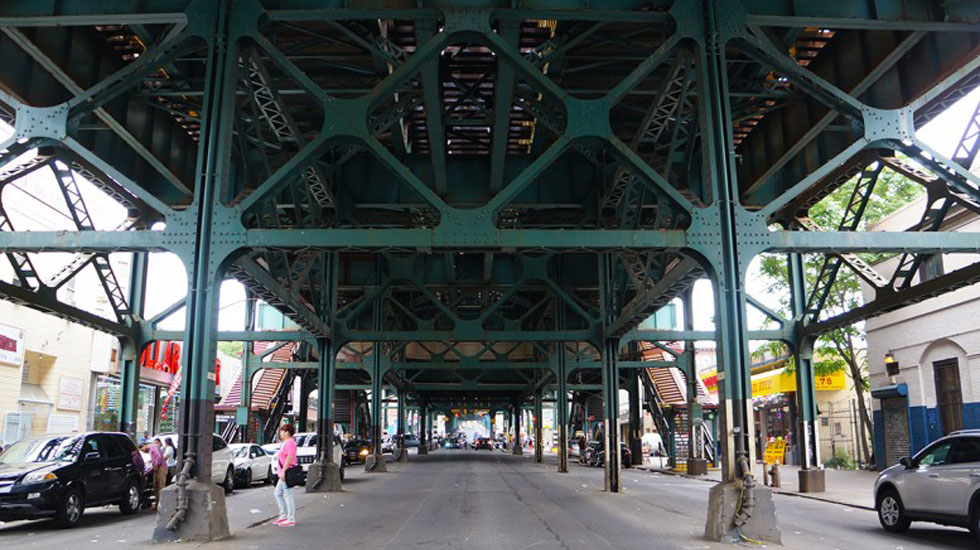
After three years of planning and contentious public meetings, the city is finally getting ready to rezone 92 blocks of Jerome Avenue, running from 165th Street in Highbridge to 184th Street in University Heights. Along the way, Jerome also passes through Concourse, Morris Heights, Mount Hope and Fordham Heights. These are some of New York City’s poorest neighborhoods: The median family income hovers around $25,900 in Bronx Community Districts 4 and 5. Two thirds of the housing stock is rent-regulated, and 80 percent of the apartments and homes were built before 1947, according to the Department of City Planning.
Most of Jerome is zoned for heavy commercial uses, like auto shops, parking lots, car washes and gas stations. And while the car repair industry and various kinds of small shops have proliferated, residential development is nonexistent. In early 2015, Mayor Bill de Blasio’s administration realized that the strip of low-rise commercial buildings along Jerome was ripe for redevelopment, and the neighborhood could play an important role in the mayor’s initial plan to build and preserve 200,000 affordable units by 2022. (The administration upped its goal last November to 300,000 units by 2026.)
The rezoning is expected to pave the way for new mixed-use, midrise residential buildings-up to 4,000 apartments, 440,000 square feet of retail and 40,000 square feet of offices across 45 development sites. And the new construction would displace roughly 98,000 square feet of auto-related businesses and 48,000 square feet of industrial space, according to city zoning documents. While the city has promised to spruce up local parks and improve lighting under the elevated subway tracks, activists wonder whether the new zoning will ultimately put the owners of auto shops, as well as their hundreds of employees, out of work.
Jerome Avenue will be the fourth major neighborhood rezoning orchestrated by the de Blasio administration, after the fiery and rushed effort to revamp East New York, Brooklyn, approved in April 2016, the under-the-radar rezoning of Far Rockaway, Queens, and the drawn-out, contentious rezoning of East Harlem that passed last November.
The Jerome Avenue proposal has wound its way through several stages in the seven-month-long public review process, winning conditional approvals from Community Boards 4 and 5 and the Bronx Borough President. Last Wednesday, a City Council subcommittee held the final public hearing on the rezoning, before the plan heads to the full council for a vote and final approval in late March. In the meantime, the area’s two councilmembers, Gibson and Fernando Cabrera, will hammer out the finer points of the land-use rules and community benefits with the de Blasio administration.
Planning officials said that the city expects to offer loans of up to $250,000 to small businesses that want to grow, relocate or meet the new zoning requirements by getting the right licenses or permits. A spokeswoman for the Department of City Planning also pointed out that the plan for Jerome has been changed to ensure that a few blocks of industrial, auto-business-friendly zoning remain along the corridor.
Many housing advocates and developers agree that for now, most of what will be built along Jerome Avenue will be subsidized affordable housing. Adam Mermelstein, whose firm Treetop Development is building a 400-unit residential project in the South Bronx neighborhood of Mott Haven where 20 to 30 percent of the units will be affordable, said that the rents along Jerome are still too low to support the construction of housing without subsidies.
A handful of landowners in the area have already committed to building 100 percent affordable housing. Maddd Equities, for example, is planning 720 below-market rentals at 1159 and 1184 River Avenue, set to be financed through HPD’s Extremely Low and Low Income Affordability (ELLA) program.
One of the best ways to prevent poorer Bronxites from being pushed out of the neighborhood could be the CONH program-if it works. The pilot program, set to launch at the end of August, will require some residential landlords to prove that they have not harassed current or prior renters in the past five years to secure permits for new construction, major alterations or demolition. (Source: Commercial Observer)





Add Comment