



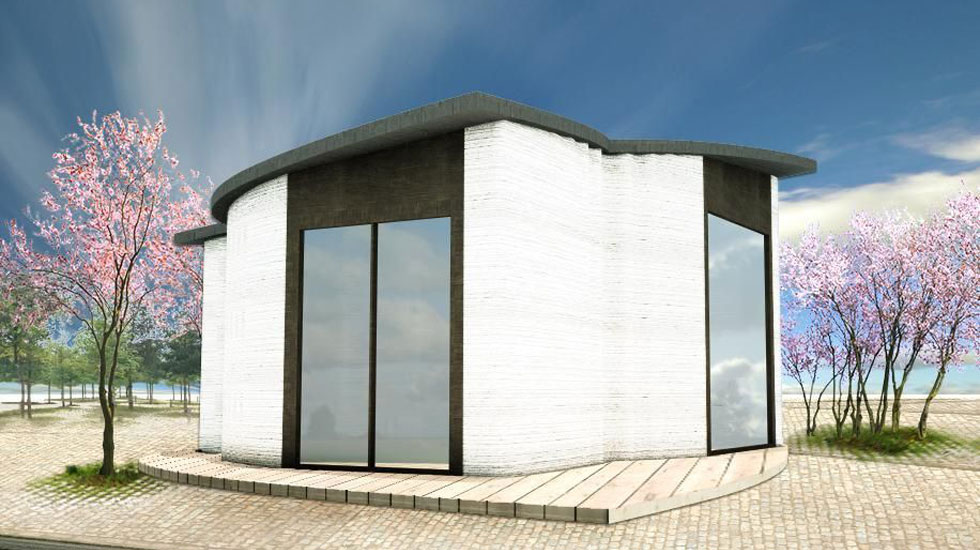
In the past decade, the ability to 3D-print buildings has become one of the latest, though still controversial, technological advancements in the construction industry.
What was once used to manufacture small objects, figurines and vehicle prototypes is now being used to construct affordable and emergency housing in developing countries.
Developers across the globe are experimenting with the cutting-edge technology, using massive 3D printers to build entire housing communities and even commercial buildings—though the technology still has a long way to go before being widely adopted in the U.S.
Though international companies have used the technology to build more cost-efficient housing (some between $4K and $10K a unit), there remains a harrowing number of questions surrounding the safety and habitability of 3D-printed houses.
Most of the innovative 3D-printed structures across the globe are one-off projects that have yet to create a regulatory pathway to getting these buildings approved so they can be mass-produced, said Jerry Neuman, a commercial real estate attorney and land-use expert with DLA Piper. There is not a system in place that would allow inspectors in the field to examine the 3D-printed buildings for structural integrity, plumbing, electrical, and other public safety concerns before providing occupancy permits.
“There are certainly discussions about 3D printing creating a low-cost alternative to housing construction, which can assist in the affordability crisis we’re seeing. That said, I think it is not a short-term solution,” Neuman said. “We haven’t really been able to create the body of regulations that would be necessary to ensure its safety or have those processes evaluated.”
How It Works
Whether they are portable printers used on-site or are housed in a warehouse, 3D printers have the potential to completely revolutionize the built environment.
The printers work around the clock to complete a structure using various materials depending on the project, from concrete, steel and plastic to more natural materials like wood or bamboo.
In a construction technique known as additive building or additive manufacturing, 3D printers essentially scan a project’s blueprints, then use softened concrete to build the structure layer after layer, somewhat like a multi-layered cake.
With construction costs skyrocketing, high housing prices and homelessness a growing issue across the country, 3D printers could greatly cut down on the labor and costs associated with homebuilding, which accounts for 61.8% of a house’s price. Questions remain regarding whether this process can be regulated in the U.S. and emulated on a large scale in the near term.
The Dream
One driving factor behind the 3D printing fanfare is the idea that these printers can be used to build homes and establish communities in developing countries, bringing shelter, electricity and plumbing to families in need.
An organization called New Story is raising funds to build 100 3D-printed homes in El Salvador. The nonprofit is partnering with Texas-based ICON, a construction tech and robotics company with a focus on affordable housing, to raise $1M and build these homes within the next two years.
The two have had success with the technology. In early March, New Story and ICON built a 3D-printed house featuring three bedrooms, a living room and an office for $4K in under 24 hours. They unveiled the home at Austin’s SXSW festival.
New Story has funded the construction of more than 850 homes in Haiti, Mexico, El Salvador and Bolivia. Most of these homes were built using blocks of concrete, took 15 days to erect and cost around $6K to complete.
Across the Atlantic in Dubai, San Francisco-based engineering firm Syska Hennessy Group partnered with the UAE Prime Minister’s Office to help design and build a fully functional 3D-printed commercial building at the Dubai Future Foundation. Known as the Office of the Future, the building is housed on Dubai’s Museum of the Future campus. The nearly 2,700 SF flexible office was built using a 20-foot-tall, 120-foot-long and 40-foot-wide 3D printer, one of the world’s largest, according to Syska.
Syska helped design the infrastructure for electrical wiring and HVAC systems to make the building inhabitable, such as integrating pathways for electrical conduits. Most of the building was printed in China, shipped in containers to Dubai and assembled on-site in 17 days, Bolin said. From start to finish, about 18 team members worked on the project, and companies involved included PMKConsult, Gensler/Killa Design and China State Construction Engineering Corp.
Academics and nonprofits are not the only ones experimenting with this technology. In New York City, architecture and engineering firm Edg plans to use 3D printers to restore the facade of historic buildings and to help design new building facades.
Edg co-founding partner John Meyer said the goal is to use 3D-printed materials to replicate a building’s existing facade or to create a new ornamental element for a building.
Structurally Sound
Though the tech offers a quicker way to deliver homes, 3D printing carries risk. For one, the concrete lacks the structural reinforcement of traditional concrete because the layers are built one atop the other.
Eindhoven University of Technology Professor of Applied Mechanics Akke Suiker created a formula to guarantee the structural soundness of 3D-printed straight wall structures. Suiker told 3DPrint.com in February that his formula helps determine the rate at which concrete layers can be piled on top of each other and remain structurally sound without collapsing or falling under their own weight.
Some experts believe the wide adoption of 3D-printed materials to build entire homes and commercial buildings is far off, and the cost cuts associated with the tech may not be worth the initial investment.
(Source: Bisnow)





Add Comment