



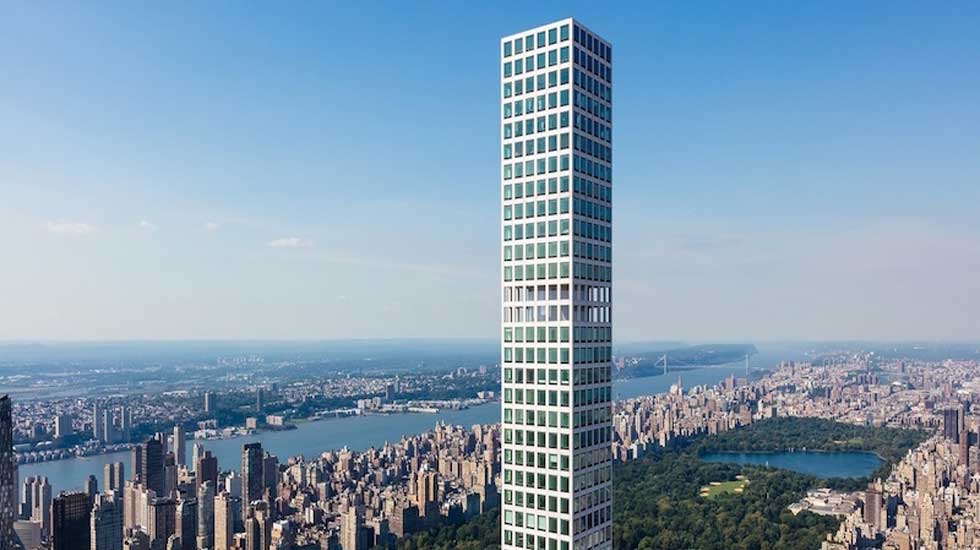
The city’s highest-end condominium towers have been blamed for casting shadows over Central Park, exacerbating the affordability crisis, and helping foreigners hide dirty money.
Now, add hastening climate change to the list.
As city government has begun collecting and publicly disclosing energy consumption in buildings, it has emerged that many of the most luxurious residential projects are also conspicuous consumers of energy.
While sustainability features have become ubiquitous in the world of commercial office space, they have been largely absent from the city’s luxury condo market. Even as green technology has become more sophisticated, cost-efficient and available, high-profile builders such as Extell Development, Vornado Realty Trust, and Zeckendorf Development have raised projects that ignore, if not mock, the goal of environmental stewardship. Several projects that are underway and have not yet reported their energy load are likely to perform just as poorly.
The trend has gone virtually unnoticed despite Mayor Bill de Blasio’s championing of a goal to cut the city’s greenhouse-gas emissions by 80 percent in the next 30 years. Roughly 70 percent of the city’s carbon footprint is from the energy used by buildings. A report by the Urban Green Council found that about 70 percent of that is attributed to office and residential properties.
“For the city to meet its climate goals, almost every building needs to drastically reduce its energy usage,” said Lindsay Robbins, a senior adviser at the Natural Resources Defense Council who studies energy consumption in the city. “It’s shocking that these high-end buildings are performing this poorly.”
The situation presents a stark dichotomy. The developers of high-profile super-luxury residences, including 432 Park Ave., 157 W. 57th St., and 20 W. 53rd. St., lure affluent buyers with prime locations, architecture by star designers, huge windows with soaring views, fancy fixtures, exotic wood, and marble—and such energy-guzzling amenities as heated pools, saunas, and temperature-controlled wine cellars.
Commensurately sophisticated carbon-conscious equipment and materials would have offset the impact. Instead, many luxury developers did not even invest in basic green systems.
According to data from 2016, the most recent released by the city, 432 Park Ave. used 214,900 British thermal units per square foot, 73 percent more than the median figure for residential buildings in the city. The building’s Energy Star score, a measure devised by the Environmental Protection Agency to reflect energy use, was a dismal four out of 100. Most multifamily buildings in the city—even if decades old—score above 50.
Reports indicate 432 Park Ave. achieved Leadership in Energy and Environmental Design certification status, perhaps the best-known sustainability scoring system. LEED certification, however, weights criteria far removed from energy consumption, such as whether construction materials are locally sourced and whether a building avoids paints and varnishes that contain harmful solvents.
Developers say people shopping for upscale apartments do not focus on a property’s energy performance, unlike many corporate tenants, which require that their space meet environmental benchmarks. Luxury residential builders have been wary to spend money on energy-saving systems that they cannot recoup from buyers.
“It’s not proven anyone will pay you a higher price per square foot for an apartment because the building is more energy-efficient,” said Joe McMillan, the principal and founder of residential development firm DDG, a rarity among condo builders in that it has received or is seeking LEED Silver or better certification for its eight projects in the city. “To go through the process of LEED is not an insignificant sum of money. It costs hundreds of thousands of dollars, at least. I believe the market will come to a point of recognizing it, but when, I don’t know.”
The race for new echelons of luxury has exacerbated the carbon toll. Besides the pools, saunas and wine cellars are amenities that more subtly suck up power, such as climate-control systems that keep apartments at a constant temperature and humidity level to prevent pricey furniture and art from swelling and contracting as seasons change.
The very shape of many new towers fosters inefficiency. Buildings have taken on needlelike dimensions in recent years so developers can reap premium prices for commanding views. Powerful elevators needed to quickly whisk tenants to residences high in the sky use more electricity than conventional lifts, and pencil-shaped buildings leave more surface area to bleed heat in the winter and cool air in the summer.
Meanwhile, concrete and glass—the materials of choice for high-end development—are among the poorest insulators. Without mitigation efforts, buildings that fit these criteria perform like energy hogs.
Rentals are more efficient
“Before 2014, there was little to no enforcement whether a property was meeting the baseline efficiency levels set by the building code,” Gina Bocra, the Department of Buildings’ chief of sustainability said. “And in 2016, we upgraded the code to be 25% more efficient than it was.”
Buildings constructed now must be about 50% more efficient than what was required in the 1980s, Bocra said.
Developers of rental properties have been notably more environmentally conscious than condo builders, in large part because it benefits their bottom line to save on electricity, fuel and water. For instance, the Durst Organization, which has been incorporating green measures across its many properties and projects in the city, installed a blackwater treatment system at the Helena and Via, two adjacent residential buildings it owns on the Far West Side. The system collects wastewater, cleanses it in a 60,000-gallon vat with special microbes and recycles it to the buildings’ toilets and gardens.
“The buildings are about 47% more efficient than buildings of this size in terms of their water consumption,” said Sydney Mainster, Durst’s director of sustainability. “It saves potable water and saves the sewer system from having to take on our wastewater, which protects the waterways.”
At John F. Kennedy International Airport, MCR Development is installing natural gas–driven reciprocating engines to fully power the new TWA Hotel, which will be completely off the power grid. Waste heat from the generators will be harnessed to provide hot water, a technique that is gaining currency. Extra energy will be stored in a truck-size battery for use during peak periods.
Other builders have recently pursued even more cutting-edge standards. Justin Palmer, founder and CEO of Synapse Development Group, adopted innovative techniques to build Perch Harlem, a 34-unit, 7-story apartment building at 542 W. 153rd St. The $24 million rental project achieved Passive House certification, one of the most stringent energy-consumption standards, which limits BTUs per square foot to 38,100, less than a third of the average.
The city’s building code now requires building owners to consult with energy experts on ways to cut electricity and fuel consumption. In 2020 landlords will be required to publicly post energy grades, akin to restaurants’ cleanliness ratings.
A gulf, however, remains between just meeting the code and pushing the boundaries of energy efficiency. Some condo developers appear focused on simply doing what is required. Extell is building the condo spire Central Park Tower; at 1,550 feet, it will be the tallest building by roof height in the city. A spokeswoman could not identify any systems or materials that will allow it to perform better than Extell’s energy dud at 157 W. 57th St.
(Source: Crain’s New York Business)





Add Comment