
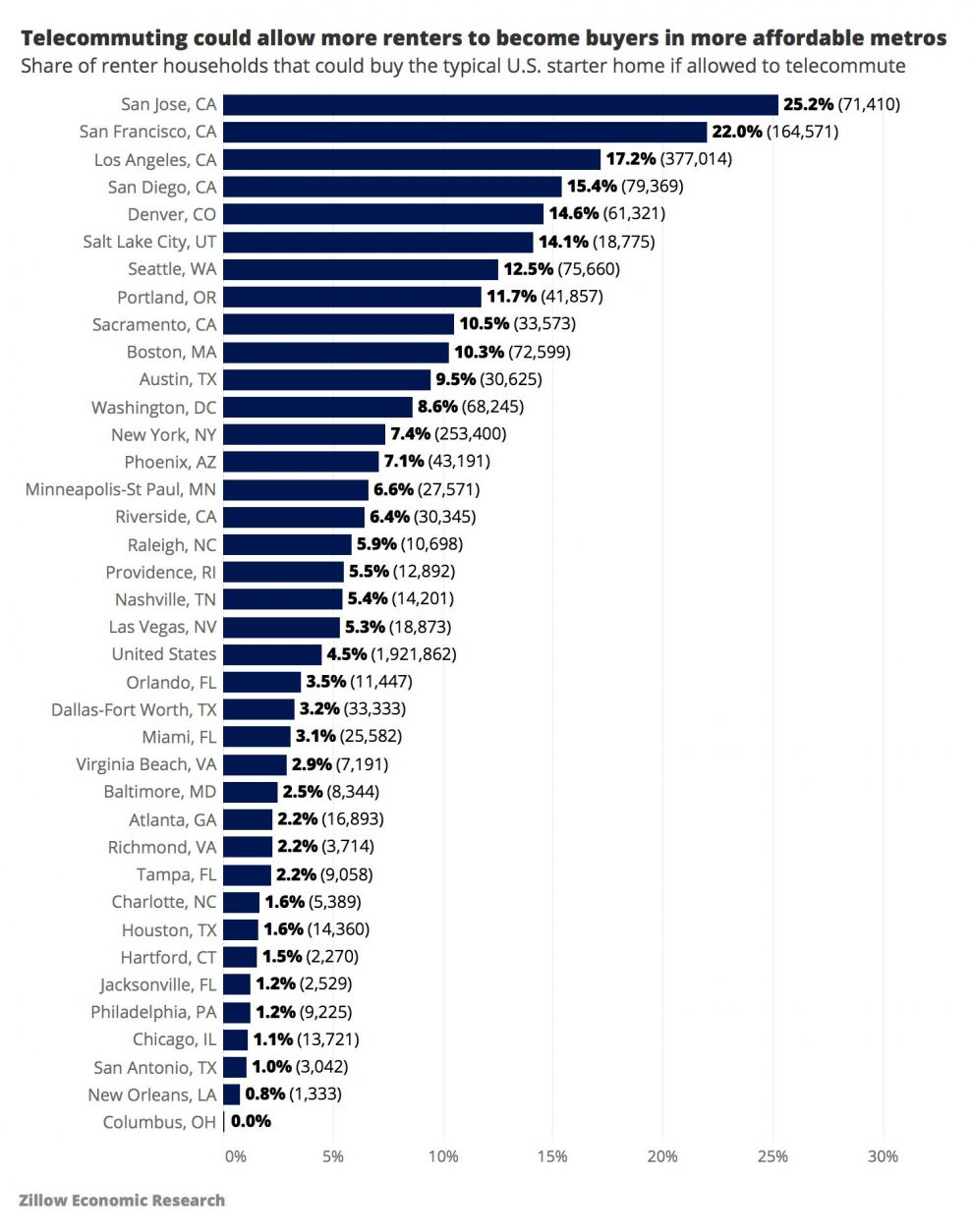
The rise of remote work has the potential to unlock the American Dream of homeownership for nearly two million renter households, according to a Zillow analysis which finds that these renter households could find an affordable starter home in a less expensive metro if they telecommute.
The numbers are more pronounced in expensive coastal metros like San Francisco, where 22% of renters priced out of their metro could afford monthly payments on a typical U.S. starter home, estimated at $725. Monthly payments on a typical San Francisco city starter home are more than seven times higher, at $5,181. More than 10% of renters who couldn’t afford to buy in the city of San Francisco, could afford a starter home within the greater San Francisco metro area, offering more options farther afield to aspiring buyers who no longer need to commute to the office five days a week.
There are exceptions. In cities such as Minneapolis, Phoenix and Denver, the opposite is true. In Denver, starter homes in the city are more affordable than in the metro area, yet 14.5% of renter households priced out of homeownership in the Denver metro could afford a typical starter home elsewhere in the country.
Nor will some renters find it more affordable to buy a home outside their current metro areas. Places such as Pittsburgh, El Paso and Rochester offer more affordable starter homes than the country as a whole, meaning aspiring buyers would have to pay more if they wanted to leave.
“If remote work becomes a bona fide long-term option especially with the pandemic, that could reshape the U.S. housing market by opening up homeownership to people renting in expensive parts of the country,” said Zillow economist Jeff Tucker. “However, it’s unclear how many people would make the move to buy their first home. Proximity to work is just one of the factors people consider when choosing where to live. Other factors may keep them from moving including proximity to friends and family, cultural and natural amenities, and their kids’ schools.”
Zillow’s analysis looked at renter households for whom monthly payments on a starter home in their metro are unaffordable, but would be affordable on the typical U.S. starter home. Those households were then assigned a probability of being able to telecommute based on income, the worker’s industry and occupation.
For example, Chris Chan, 40, and his wife, Eunice Lee, 35, became home buyers during the pandemic, moving from a two-bedroom co-op in Brooklyn to a five-bedroom house in Westchester County, New York.
“The tipping point was envisioning both of us working from home indefinitely alongside our daughter and a second child on the way,” said Chan, who works in Connecticut. “We wanted to maintain the balance between space and proximity to the city. We could get more for our money just outside city limits and we’re still only 30 minutes from Grand Central Station.”