



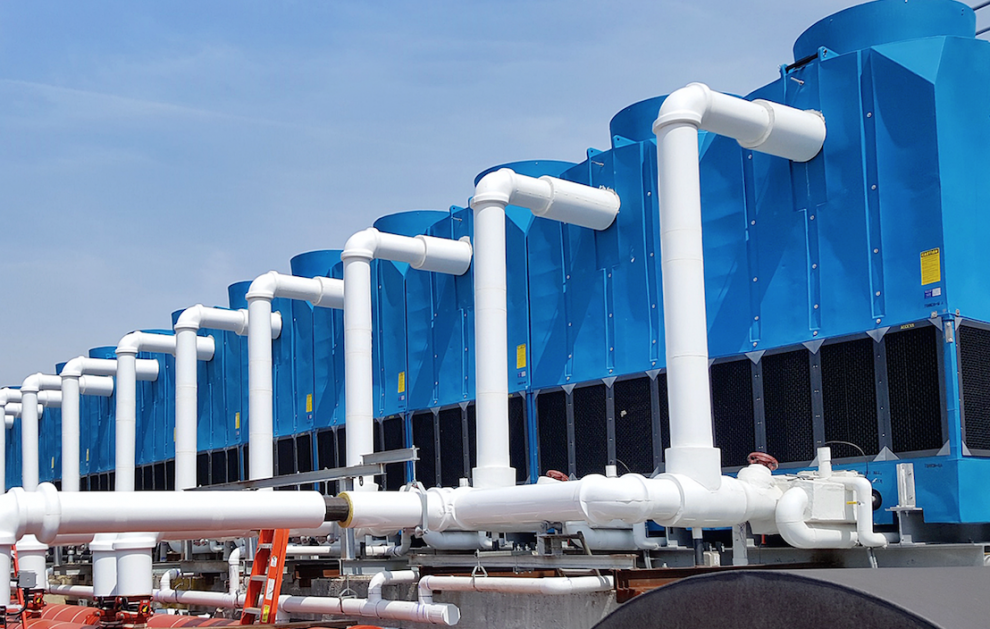
NYC Health + Hospitals, The LiRo Group, and the New York Power Authority (NYPA) have completed the installation of the first antimicrobial cooling tower ever installed in New York City. The specially designed, highly efficient cooling tower was installed on the roof of NYC Health + Hospitals/Lincoln, a medical center located at 234 Eugenio Maria De Hostos Boulevard (also known as East 149th Street) in the South Bronx. As Owner’s Representative for NYPA, The LiRo Group has managed the entire design and construction process for the new system.
NYC Health + Hospitals/Lincoln is a full-service acute care hospital and is considered one of the premier trauma centers in the country. The hospital’s Level 1 Trauma Center is the busiest in the northeast, with 144,000 emergency department (ED) visits and 550,000 clinic visits each year. The hospital houses 362 beds.
The new tower not only supports the air conditioning system, but also offers antimicrobial features that significantly reduce the risk of harmful bacteria that sometimes grow in less advanced cooling towers. The new cooling towers replace ones that had reached their expected end of life. While the old system never contributed to any health concerns, leaders at the hospital nevertheless saw an opportunity to increase protections. Following research of replacements models, the cooling tower model selected was chosen because of several innovations.
“The $11.5M project incorporated installation of both the new cooling tower and a new, energy-efficient roof. The old cooling tower and roof were original to the building, which was built in 1972. The new equipment and roofing materials provide NYC Health + Hospitals, NYPA, and the Lincoln facility itself with an incredibly efficient, cost-saving, and ultra-reliable infrastructure. The new cooling system is expected to lower the energy cost by 40 percent in comparison to the operational costs of the retired system,” said Luis M. Tormenta, PE, LiRo’s Chief Executive Officer and Vice Chairman. “In addition to providing antibacterial properties, the new tower requires a great deal less maintenance than the outdated unit we took down,” Tormenta continued.
“We worked with New York Power Authority’s team to ensure that the new cooling towers would be as energy-efficient as possible,” said Louis Iglhaut, associate executive director at NYC Health + Hospitals, who led the team responsible for selecting and installing the new cooling towers. “Our old towers used large, 48-horsepower fans on each unit, which required the use of a lot of electric power. The new modular units are equipped with smaller 5-horsepower, 18-inch fans, so the energy consumption is far less.” He adds that they also installed variable-frequency drives, which increase energy savings.
“New York City’s public health officials have worked proactively to curb outbreaks of Legionnaires’ disease in the five boroughs,” said New York State Assembly Health Committee Chair Richard N. Gottfried. “But Legionnaires’ is unpredictable and difficult to eradicate. By installing this state-of-the-art technology, Health + Hospitals is continuing to act with vigilance and prudence to protect the people of New York City.”
Enhanced safety to the community was a significant factor. The model selected has features that prevent or impede the potential growth of bacteria, including Legionella, which can cause a type of pneumonia commonly known as Legionnaires’ disease. The shells within the towers that hold the water are infused with an antimicrobial resin—wide-spectrum additives that operate on a cellular level to continuously disrupt and prevent uncontrolled growth of microorganisms and biofilm. In addition, while traditional metal cooling towers are vulnerable to corrosion from salt air and industrial gasses, the new towers’ high-density polyethylene design is resistant to such corrosion. Moreover, it is also resistant to the harsh chemicals required for use in treating the recirculating water and cleaning the towers.
In addition, the shells that hold the water have a rounded shape, as opposed to the boxy shape of traditional shells, with corners in which water moves less and bacterial growth can flourish. The rounded shapes do not allow water to become dangerously stagnant in spots.
Another major appeal of the model was the promise of energy savings. To meet the city’s mandate to save on energy, NYC Health + Hospitals teamed up with the New York Power Authority, a state power organization dedicated to innovative and energy-efficient infrastructure. NYPA retained The LiRo Group, a leading U.S. engineering, technology, and construction management firm based in Manhattan and Syosset, NY to oversee the project as Owner’s Representative.
The new cooling tower is composed of 24 model TM-605412 units by Delta Cooling Towers, organized in three sections, with a cooling capacity of 1,692 tons per section. The tower provides a cooling capacity of approximately 5,076 tons total. Before this project started, the hospital had five Marley units with a total capacity of 5,000 tons. Due to its efficiency, the new system will provide an annual energy use saving of approximately 239,376kw, which represents savings of $26,332 per year.
In addition to NYPA, LiRo, and manufacturer Delta Cooling Towers, the project team included contractor Maric Mechanical, Inc., and Engineer of Record Lizardos Engineering Associates, P.C.





Add Comment