




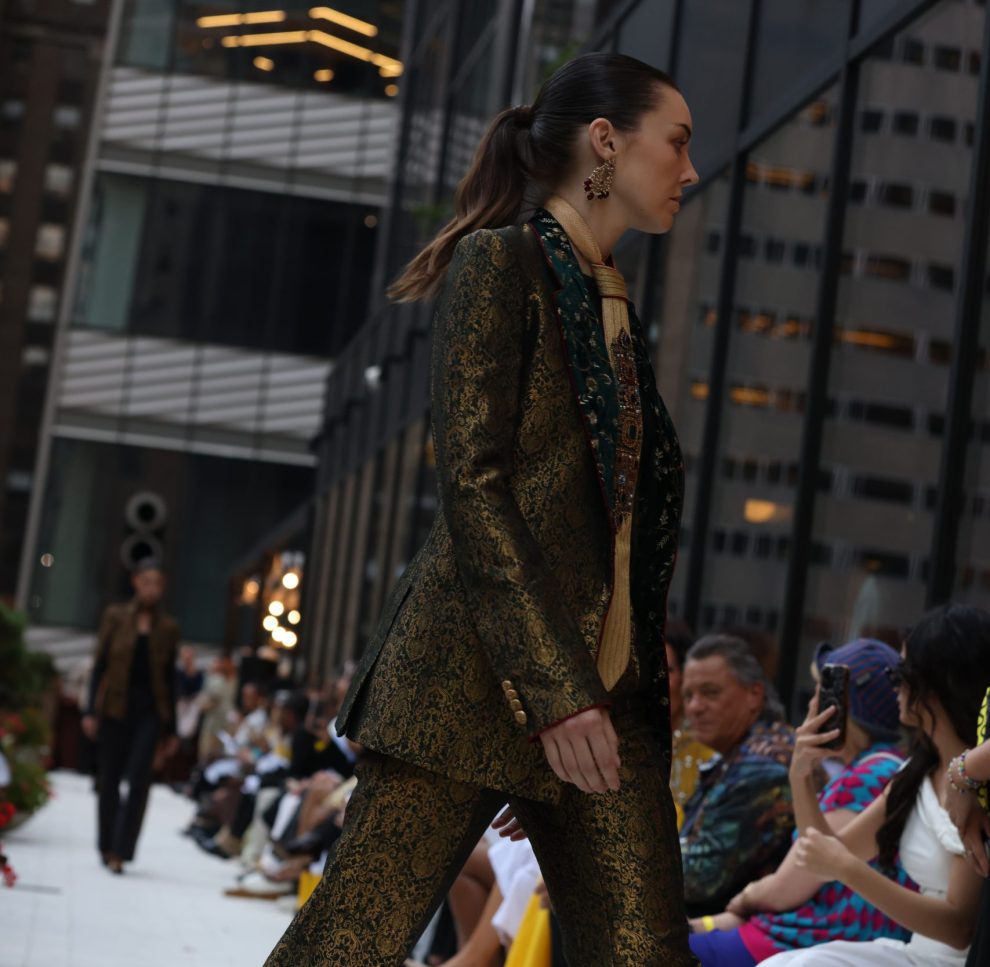
Pakistani couturier Parishae Adnan closed Flying Solo’s Spring/Summer 2027 show during New York Fashion Week with Second Skin, an eight-look collection created from archival garments and deadstock textiles. Bringing the show to its finale, Adnan presented a body of work rooted in reconstruction, craftsmanship and the transformation of existing garments into contemporary couture.
Second Skin asks what couture could become if it were designed for more than one life. Rather than treating circularity as a compromise, Adnan presents it as an evolution of luxury: one that allows a garment’s material, memory and labor to outlive its original form. Each piece begins with something that already carries a history, then moves through a process of careful dismantling, preservation and reinvention.
For the collection, Adnan deconstructed completed garments and rebuilt them through tailoring, corsetry, hand embroidery and radical shifts in proportion. A menswear waistcoat was reshaped around the female body. A bridal lehenga, a long, heavily embroidered skirt dating from approximately 2008, became a sculpted bustier and miniskirt. Suede recovered from an unsold sherwani, a tailored coat traditionally worn by men for formal occasions, was recut into an open, cropped jacket and ultrawide trousers. A pishwas, a traditional South Asian dress with a fitted bodice and flowing skirt, became a floor-length tailored coat while retaining its dense gold embroidery.
“I see old pieces that are handmade like old architecture, and destroying them would mean deleting history. When you recognize this history behind the garment—the time, the labor, the love—you will do anything to restore them. So I make a new cut or silhouette, and it acts as scaffolding, reinforcing the architecture of the old pieces,” Adnan said.
The collection examines how clothing communicates power, drawing on menswear, military dress, bridal wear and traditional ceremonial clothing before rebuilding those codes around the female body. Across the eight looks, sharp tailoring, strong shoulders and a tie gradually give way to corsetry, exposed structure and exaggerated volume. That progression creates a visual narrative of release: inherited forms are not erased but opened, shifted and allowed to occupy new space.
The opening look, “My Father’s Tie,” reshapes traditional masculine tailoring around an exaggerated hourglass silhouette. The green-and-gold brocade suit is anchored by a gold raw-silk tie, hand-embroidered by Adnan’s father—Pakistani designer Amir Adnan—for a 2001 collection. Its appearance places family history at the beginning of the collection while establishing her approach to inheritance as something active rather than static.
The fourth look, “Exoskeleton,” began as an embroidered menswear waistcoat presented in December 2024. For Second Skin, the garment was taken apart and reconstructed for the female body, with its pleats and darts pushed outward rather than concealed. The visible framework preserves evidence of the original garment while making its transformation part of the finished design. Construction is not hidden beneath the surface; it becomes the surface.
The technique is rooted in fabric manipulation, using the existing cloth to create structure and dimension rather than relying solely on applied embellishment. Pleats and darts, traditionally used to quietly control fit and shape, are exaggerated and redirected outward to form a sculptural exoskeleton around the body. By exposing these construction devices, the garment turns the mechanics of tailoring into a decorative, architectural element.
The collection reaches its fullest volume in the seventh look—a sweeping tulle ballgown—before closing with “Reincarnation.” This final look transforms a traditional pishwas from the same December 2024 presentation into a floor-length coat. Although its original silhouette no longer exists, the hand-embroidered black velvet survives in a different form, carrying the workmanship of the earlier piece forward rather than consigning it to an archive.
Raised in her family’s fashion workshops, Adnan treats inheritance as material to work with, not something that must remain untouched. Second Skin incorporates brocade from previous collections, textiles originally used by her father and suede recovered from an unsold garment. Individual looks represent upwards of 2,500 hours of workmanship, with much of the collection developed and finished by hand. Intricate embroidery is built up over hundreds of hours, while tailoring, corsetry and fabric manipulation give each piece its structure. The scale of the workmanship is perhaps most apparent up close, where the density of the embroidery and the precision of the construction reveal just how much work lies behind each look. It is an approach to making rooted in the traditions of couture, where time, technique and the hand of the maker remain visible in the finished garment.
The presentation was attended by members of New York’s creative community, including Grammy Award-winning musician Arooj Aftab, artist and influencer Sufi, and actor Anika Zulfikar. Also in attendance was Adnan’s mother Huma Adnan, a celebrated designer and pioneer of sustainable fashion in Pakistan. The attendee list brought together voices across music, art, fashion and film, reflecting the broader creative community surrounding the presentation.
Rooted in South Asian craft and expressed through a contemporary couture vocabulary, Second Skin challenges established ideas about where couture comes from, what it can look like and how long it should be allowed to live. Through garments that hold both visible history and new possibility, Adnan proposes a model of luxury defined not by novelty alone but by time, skill, provenance and transformation.


