




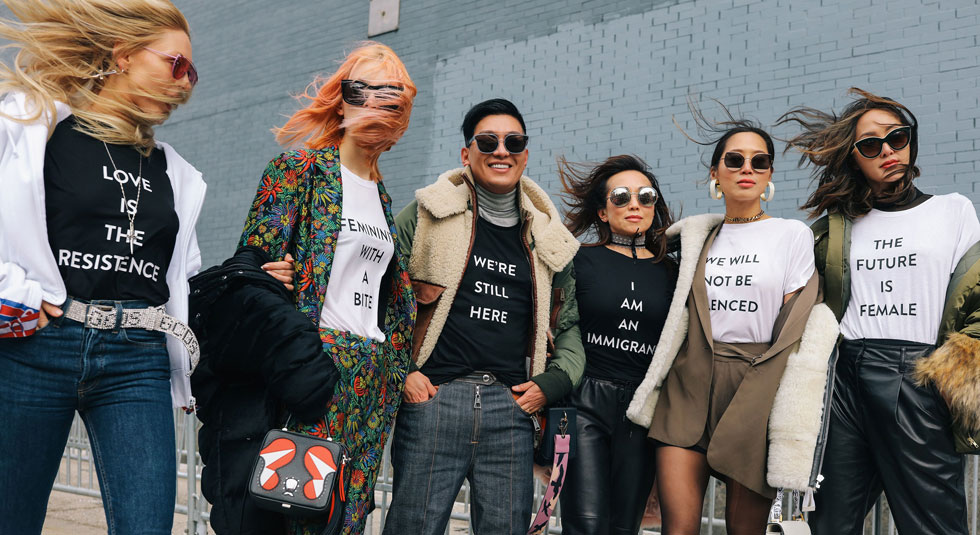
Clothing can send a powerful message, but when it comes to activism, how much does it contribute to the conversation?
Fashion has always been known to reflect what is going on in the world. Or as Coco Chanel once put it, “Fashion is not something that exists in dresses only. Fashion is in the sky, in the street; fashion has to do with ideas, the way we live, what is happening.”
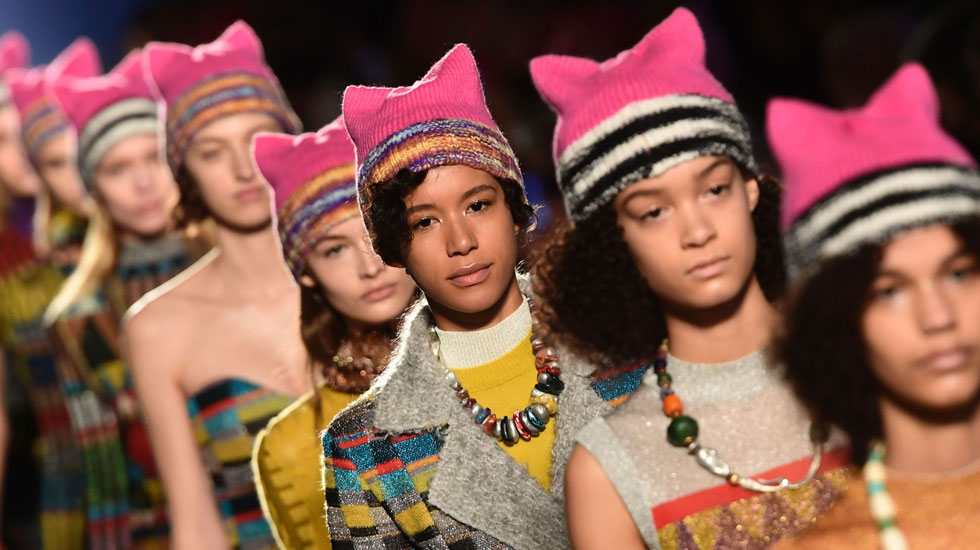
Now more than ever we are seeing these reflections present in the fashion choices of everyone from celebrities to your coworker Jan. At the Golden Globes in January, Hollywood A-listers donned all-black garbs in honor of Me Too and Time’s Up, movements that started because of the dozens of sexual assault and harassment allegations brought to light across many industries, and the knowledge that women are still paid less than their male counterparts and recognized less for their accomplishments. Jan donned a pink pussy hat and a “We Should All be Feminists” tee in January at the Women’s March, joining millions of other women fighting for gender equality.
To some people, fashion is just fashion: a way of expressing the self or showcasing personal style. But to others, fashion is a platform to express viewpoints and spark conversation on important issues.
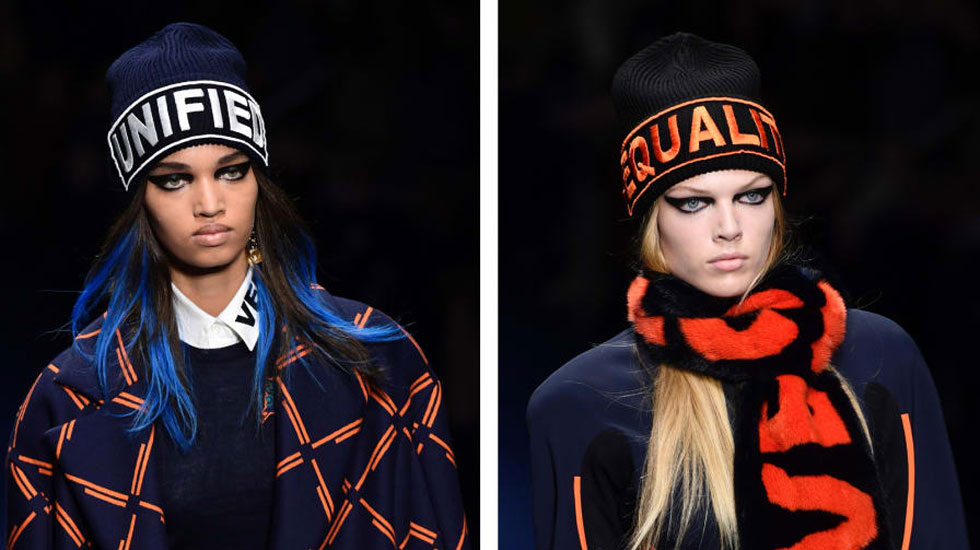
Designers including Rick Owens, Vivienne Westwood, Stella McCartney, and Miuccia Prada have consistently used the runway to ignite public dialogue around issues including animal rights, body image, the refugee crisis, equality, and diversity. Not to mention we’ve seen many political slogan tees the past few seasons from the likes of Dior, Public School, Prabal Gurung, and Opening Ceremony.
This is nothing new. For decades clothes have been an accessible point of protest in social and political movements.
Early suffragists wore white with colored ribbons to promote their movement, which included political clubs and lobbying for women to run for office. Emmeline Pethick-Lawrence, a member of the militant British suffragette group the Women’s Social and Political Union, asked protesters in 1908 to wear one of three symbolic colors at a suffrage rally: white for purity, purple for dignity, and green for hope. After the suffragette movement ended, it became common for female politicians and their supporters to wear white as a callback to the movement. During the last presidential election, Democratic nominee Hillary Clinton and her supporters adopted suffragette white as a symbol for her campaign.
In the 1920s the flapper movement was a direct reaction to society’s attitude of what was deemed as “feminine.” The loose-fitting flapper dresses and short bob haircuts were a stark contrast to the corseted dresses and elaborate hairstyles that were considered the feminine norm, subsequently revolutionizing the perception of femininity.
During World War II, French women wore hats and accessories both to stand against Nazi occupation and to celebrate French culture. And when the arts were under attack, they decorated themselves in symbols, literally sewing resistance into their clothing.
In the 1960s, civil rights protesters wore denim overalls, the uniform of agricultural workers and working class black in the South at the time, to show solidarity and build camaraderie. Later in the decade, the beret became the irrevocable symbol of the Black Panther Party, which worked towards combating white oppression. In the last two years, we have seen a resurgence of this symbol with Beyoncé’s Panthers uniform-inspired looks for her performance at the 2016 Superbowl and Maria Grazie Chiuri sending all her models down the runway wearing leather berets for Dior.
In the same era, young women wore miniskirts as a form of feminist protest against double standards and women’s right to wear whatever they wanted. This followed right on the heels of the sexual liberation movement and the introduction of the birth control pill.
In 1983, British designer and activist Katharine Hamnett gave birth to the slogan T-shirt, printing “Choose Life” in block letters on an oversized tee—possibly her most famous slogan tee to date. In 1984, Hamnett showed up at 10 Downing Street to meet then-Prime Minister Margaret Thatcher wearing a tee that said “58% Don’t Want Pershing” (a reference to stationing nuclear missiles in parts of Europe), which later became the year’s most widely-published image.
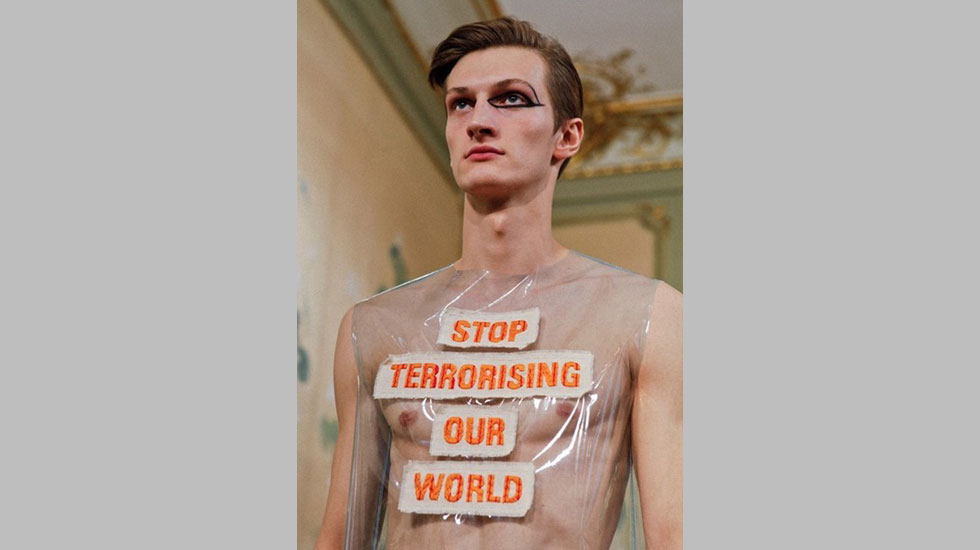
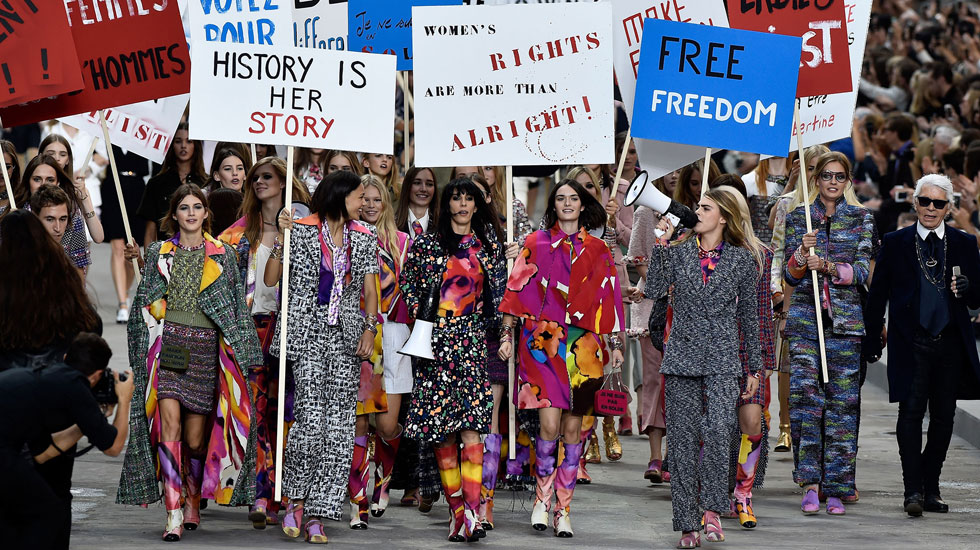
In more recent times, it’s this coming together of activism and luxury brands that have lead to some of the most direct examples of real change through fashion. In 2015 for Chanel’s SS15 show, Cara Delevingne led an army of rioting models down the Boulevard Chanel for a staged feminist protest, chanting words of empowerment and brandishing signs like “Feminist but feminine” and “Ladies First,” in one of the most overtly political fashion shows of all time. And shortly after the Charlie Hebdo shooting, Walter Van Beirendonck executed a beautifully poised show during Paris Fashion Week in response to the acts of terrorism. Though one male model bore an appliqué with the explicit directive “Stop Terrorising Our World,” in general the collection sought to counter the attacks indirectly, by presenting a diverse ode to beauty and critiquing the censorship of artists.
While the choice of color or style of clothing can play a role in how we make a stand, so can a lack of clothing. The most notable clothing-free campaign is probably that of PETA. Since 1994, the animal rights organization’s campaigns have features celebrities, athletes, and models posed fully nude with the slogan “We’d rather go naked than wear fur.”
Additional movements have used nudity as a foundation to create debate. In 1993 at the Lollapalooza festival, the band Rage Against the Machine held a nude protest onstage against music censorship. In 2015 a collective of older women farmers in Uganda stripped down to protest loss of land. Russian protest punk group Pussy Riot are as famous for their use of the naked female body as they are for their colorful balaclavas. And Ukrainian protest group FEMEN often scrawl slogans on their bare bodies to speak out about sexism, censorship, and objectification of women.
So what does all this mean?
In a discussion on NPR’s Code Switch podcast last year, producer Juleyka Lantigua-Williams stated that to really be active and helpful in a cause you have to “have something that you give up.” She continued, saying that showing up to a march, signing a petition, retweeting a hashtag, or wearing a t-shirt wasn’t enough. You need “an approximation of what it’s like to live without the privilege that you have grown up with your entire life.”
In the same podcast activist and blogger ShiShi Rose commented, “I think people get so wrapped up in what label they’re going to put on, and how it looks, and how that’s going to appear to everybody else—and not enough about the action that they’re doing.”
At the 2017 Port Eliot Festival in Cornwall, Vogue’s Chief Critic, Sarah Mower, posed the question, “Can fashion be utilized as a valid form of protest?” This question is difficult to answer. Some will say yes, and others, no. At the end of the day, the most important thing you can do is show up. But there is still something to be said for a dress, a T-shirt, or a jacket that leaves an imprint on someone’s mind.
Photo Gallery


Add Comment