




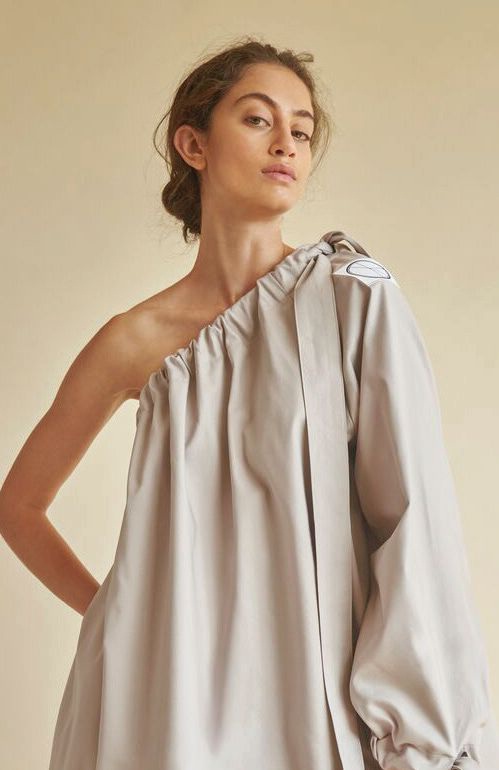
House of Nonie Founder Nina Kharey sets an example for ethical brands
It’s not often that you find a brand that stays true to its founder’s philosophy, but contemporary Calgary-based womenswear label House of Nonie is that kind of brand. The Fashion Mannuscript sat down with Founder and Creative Director Nina Kharey to learn more about her about her story, accomplishments and direction.
We first met Kharey at New York Fashion Week Spring Season 2020 (NYFW SS2020) on a panel about women supporting women, and since then, she has continued to pioneer her socially-conscious and environmentally-sustainable brand. Whether she’s taking a stand against bullying, testing out sustainable fabrics or building community through discussion, Kharey continues to use her art form to do good.
How did you get interested in fashion and design?
My parents came from India in the ‘70s, and they were in the manufacturing industry. My dad managed a knits company, and my mom was a seamstress for menswear, so she did suits. They would take me into work. My brother would go to school and I would go with them, and I learned everything just by watching them. I remember my dad showing me a sketch of something and then showing me the piece actually made, and that was the point when I fell in love with the whole design side of things.

What prompted you to begin your career in design?
Just the thought of someone wearing your thoughts and making something tangible out of it. [My parents] were very clear, though, that it was not for me. They wanted me to do something bigger. So I went to school, and my options were pretty much to go into medicine, be a lawyer or an engineer, so I got my degree in [computer] engineering. And at that time, I had lost my older brother to violence. That’s really what propelled me into this career. He was an advocate of me getting to do what I wanted to do, and that really brought a lot of peace into my life. So I went into this as a hobby, and 2016 is when I quit my day job and did it full time. I just went for it.

What inspires you?
I always look to the East. It’s what I grew up wearing. I look at Indian wear, I look all over Asia, just anything … I draw inspiration from my Eastern heritage.
What materials and colors do you like to use?
I love using heavier materials, so I use a lot of wool and a lot of medium-weight to heavyweight cotton. Lately I’ve been using a lot of silk and silk chiffon. Those are primarily my fabrics that I work with. I don’t use that much color — this last season I did a bit more — but I tend to not do patterns too much.
Meghan Markle was just seen wearing one of your dresses on her visit to South Africa; what does that mean to you as a designer?
[It] was an interesting day because it showed that she keeps the piece as a staple — because she wore it twice — which is a great feeling for me; someone like that doesn’t have to wear something twice. She can pretty much have everything she wants when it comes to clothing. Part of what I want to do is make women feel good when they’re wearing my line. It must be doing that for her as well. It’s such an honor to get that stamp of approval from her.“I COULD HAVE TURNED TO HATE AND NEGATIVITY. … BUT I CHOSE THE PATH OF LETTING LIFE FIGURE IT OUT. I CHOSE LOVE INSTEAD”

How do you source your materials and manufacturing?
We manufacture in Vancouver [Canada], and everything is handmade there. Most of the women that work with me are immigrants, and this is their only expertise. They’ve been trained to do this. If we were to take the work away from them, they probably wouldn’t find another job. It’d be very difficult for them. They’re paid very fairly, and the conditions they work in are normal conditions in Vancouver.
I also work with farms in Peru. I started doing knits down there with women who knit while they’re taking care of the children, so that helps their economy grow as well.
Tell us about your partnership with Telus and the #EndBullying campaign.
Bullying is very close to my heart; I lost my brother because of it. It’s something that I try to work with. I work with the police here in the city and meet with kids that are troubled or that are being recruited by gangs. I’ve been doing that for the last eight to 10 years.
Telus touched me with [its] anti-bullying campaign. It just sat really well with everything I do. So [it] wanted me to design something, and [it] gave me full creative freedom on making a T-shirt with something that really means something to me. And I came up with “Love gives freedom” from a quote by Rabindranath Tagore, and it really hit home, because I could have turned to hate and negativity — because the people that did this to my family are still free, and we know who they are — so that could have destroyed me. But I chose the path of letting life figure it out. I chose love instead. And through that I’ve been able to live my life. I’ve got a career going, I’ve got a family with two little kids, I’m able to grow my life just trusting that life will go the way it does and to lead with love. So that’s why that shirt really hit home with me.
At NYFW SS2020, you spoke about making space for other women of color in various industries. Can you tell us about your journey towards inclusion in fashion?
I’m a short, little brown girl, and you just really feel it sometimes. Especially in the industry, when most of the people surrounding you are men — you really feel it at that point. And it’s not easy for [South Asian women] in our own home to get up and do what we want to do because usually our cultural barriers are holding us back as well. Even my parents were super confused about me wanting to do this. And still to this day, I hear it from time to time, “Just stay home and take care of the kids” type of thing. So we have to work really hard to do what we do and be recognized for it, and there are so many South Asian women doing that.
What are your goals for Nonie?
I would love to do more conversations like [the NYFW panel] with each season. I would love to meet more people in the industry and have conversations that are relevant to the times right now and talk about why I design the way I do, why the pieces come out the way they do. That way, you get a lot of background on all the collections and all the designs, because I really do believe that … when someone buys [one of my designs], they’re really buying my ideologies and thoughts. It’s truly my art that’s coming out of me, not just clothing.


