


Exhibition includes original German-made Model 2 freight train car used for deportation of Jews to ghettos and extermination camps; barrack from Auschwitz III-Monowitz; Picasso’s Lithograph of Prisoner; original drawings by Alfred Kantor and David Olère; unpublished memoirs and personal artifacts
Next week, the Museum of Jewish Heritage – A Living Memorial to the Holocaust will open the most comprehensive Holocaust exhibition about Auschwitz ever exhibited in North America. Auschwitz. Not long ago. Not far away.is produced in partnership with the international exhibition firm MusealiaandtheAuschwitz-Birkenau StateMuseum in Poland. The groundbreaking exhibition has been curated by an international team of experts led by historian Dr. Robert Jan van Pelt. It runs through January 3, 2020 in New York City.
For the first time, 74 years after the liberation of Auschwitz, a traveling exhibition dedicated to the historical significance of the camp is being presented to a U.S. audience. The exhibition’s May 8 opening marks the anniversary of VE Day or Victory in Europe Day, 1945, when the Allies celebrated Nazi Germany’s surrender of its armed forces and the end of World War II in Europe.
Featuring more than 700 original objects and 400 photographs, mainly from the Auschwitz-Birkenau State Museum, the New York presentation of the exhibition allows visitors to experience artifacts from morethan20international museums and institutions on view for the first time in North America, including hundreds of personal items—such as suitcases, eyeglasses, and shoes—that belonged to survivors and victims of Auschwitz. Other artifacts include: concrete posts that were part of the fence of the Auschwitz camp; part of an original barrack for prisoners from the Auschwitz III-Monowitz camp; a desk and other possessions of the first and the longest serving Auschwitz commandant Rudolf Höss; a gas mask used by the SS; Picasso’s Lithograph of Prisoner; and an original German-made Model 2 freight wagon used for the deportation of Jews to the ghettos and extermination camps in occupied Poland.
“Auschwitz and the Shoah are not just another single, dramatic event in the linear history of humanity. It is a critical point in the history of Europe, and perhaps the world,” said Dr. Piotr M. A. Cywiński, director of the Auschwitz-Birkenau State Museum.“While commemorating the victims of Auschwitz we should also feel moral discomfort. Antisemitic, hateful, xenophobic ideologies that in the past led to the human catastrophe of Auschwitz, seem not to be erased from our lives today. They still poison people’s minds and influence our contemporary attitudes. That is why studying the Holocaust shouldn’t be limited to history classes. It must become part of the curricula of political and civic education, ethics, media, and religious studies. This exhibition is one of the tools we can use,” he explained.
The Museum of Jewish Heritage has incorporated into the exhibition more than 100 rare artifacts from its collection that relay the experience of survivors and liberators who found refuge in the greater New York area. These artifacts include: Alfred Kantor’s sketchbook and portfolio that contain over 150 original paintings and drawings from Theresienstadt, Auschwitz, and Schwarzheide; the trumpet that musician Louis Bannet (acclaimed as “the Dutch Louis Armstrong”) credits for saving his life while he was imprisoned in Auschwitz; visas issued by Chiune Sugihara, a Japanese diplomat in Lithuania often referred to as “Japan’s Oskar Schindler”; prisoner registration forms and identification cards; personal correspondence; tickets for passage on the St. Louis; and a rescued Torah scroll from the Bornplatz Synagogue in Hamburg.
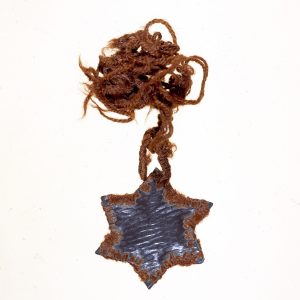
Margit (Manci) Rubenstein made this Star of David necklace from material taken from the lining of her shoes and shoelaces while imprisoned in Auschwitz (1944).
Collection of the Museum of Jewish Heritage. Gift of Sugar siblings in memory of Rosenfeld & Schwartz families
“As the title of the exhibit suggests, Auschwitz is not ancient history but living memory, warning us to be vigilant, haunting us with the admonition ‘Never Again.’ It is a prod to look around the world and mark the ongoing atrocities against vulnerable people,” said Bruce C. Ratner, Chairman of the Museum’s Board of Trustees. “While we had all hoped after the Holocaust that the international community would come together to stop genocide, mass murder, and ethnic cleansing, these crimes continue. And there are more refugees today than at any time since the Second World War. So my hope for this exhibit is that it motivates all of us to make the connections between the world of the past and the world of the present, and to take a firm stand against hate, bigotry, ethnic violence, religious intolerance, and nationalist brutality of all kinds.”
Auschwitz. Not long ago. Not far away.at the Museum of Jewish Heritage – A Living Memorial to the Holocaust is made possible with lead support by Bruce C. Ratner, George and Adele Klein Family Foundation, Ingeborg and Ira Leon Rennert, and Larry and Klara Silverstein & Family. The exhibition is presented in part with major support by The David Berg Foundation, Patti Askwith Kenner, The Oster Family Foundation, and The Bernard and Anne Spitzer Charitable Trust. The New York premiere is made possible in part by Simon & Stefany Bergson with additional support from The Knapp Family Foundation.


