


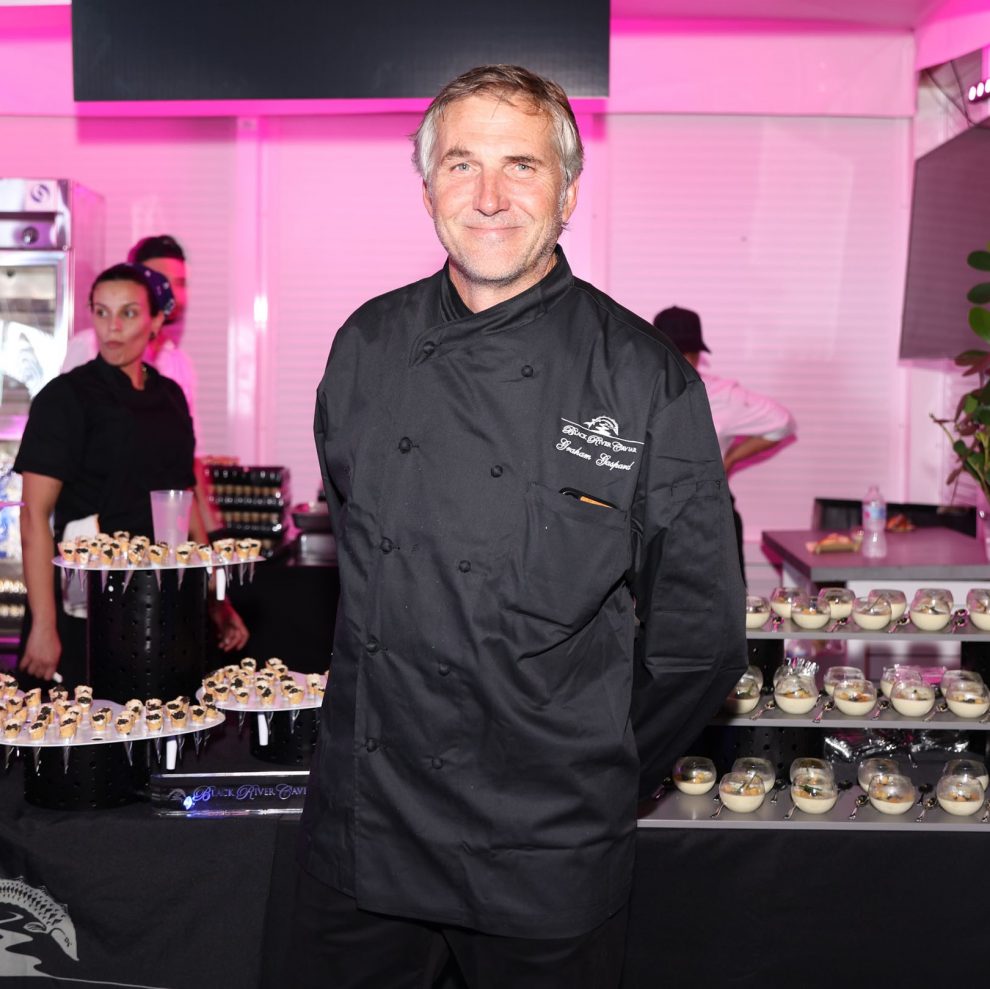
Ice flows through the veins of some men. Caviar flows through Graham Gaspard’s. Rich, authentic, rare caviar. This seasoned executive has 20 years of subject matter expertise in this extraordinary business. As CEO of Black River Caviar, Graham has invested his career in finding and delivering the finest in sustainably harvested caviar for demanding customers across the globe. He works with top chefs, Michelin-rated restaurants, five-star resorts and cruise lines, and he has recently attended the Big Sur Food & Wine Festival in California. He shared with us his insights on caviar and the market for it in the U.S.
Obviously, caviar is not just any type of fish eggs. What is caviar, exactly?
It is the roe, or eggs of a sturgeon, which is a specific kind of fish.
Why is caviar so expensive?
That’s a good question. It is a highly involved process to produce caviar. We need to grow the sturgeon, which takes a minimum of six to seven years to develop a mature sturgeon. If the conditions for growing are not perfect, the entire investment could be lost. It could be a little like laying down a fine bourbon to age for seven years, and then watching the warehouse burn down.
So there’s a “rarity/value equation.” Haven’t sturgeon farms helped make it more affordable?
Not so much, because demand has risen to meet supply. Especially with higher grades of oscietra. Also, keep in mind that along with risk, it is a labor-intensive business.
According to a recent Business Insider story, there are more than 2,000 sturgeon farms. How does this impact the industry?
The number of farms that produce any quantity that would impact the market are well below 100. I guess you could say there are over 2,000 farms if you include an individual with a pond with a few sturgeons swimming around. But there are simply not 2,000 producers.
Why do caviar fans love it so much?
Great caviar combines rich, deep, buttery yet nutty flavor that simply does not exist in any other food. Sometimes it has a slight earthy taste, but rarely vegetal, and it should never be algal. The nuttiness resembles that of hazelnuts, and the finish is close to a triple crème brie, as it hits the back of your tongue. If the texture of the caviar is firm, as it should be (not flat), then all the better. Lastly, good caviar doesn’t have acidity or bitterness.
How is sturgeon protected today?
In the States, it is the U.S. Fish and Wildlife Service along with the National Oceanic and Atmospheric Administration (NOAA), which act as the main authorities protecting sturgeon. This has been important for decades because illegal activity still exists in the business. They rarely inspect sturgeon farms unless an import/export issue arises. The Food and Drug Administration does inspect farms’ packinghouses to enforce protocols that protect consumers, as they do with all food production, especially seafood.
Let’s talk about Kaluga Queen Caviar from China. Is it regulated and safe?
I believe it is safe. The U.S. is likely their largest market. Despite perceptions about Chinese business, this product is well managed, and the Chinese government has done a great job protecting the brand. I’m not a fan of China’s oscietra; but I am impressed with their Kaluga hybrid, and I’m comfortable selling it.
What is your favorite caviar, and why?
A great oscietra with all the attributes I previously mentioned. I like my caviar “malossol,” Russian for low or little salt. Also, there are some excellent caviars coming from Israel and Uruguay farms right now. The sturgeon swim in fresh river water that flows through the facilities, as opposed to recirculated water.
How do you serve or present caviar?
With champagne or another dry bubbly. With blinis or on a potato chip. My latest favorite is leek and potato vichyssoise with a scoop of caviar on top. Incredible!


