


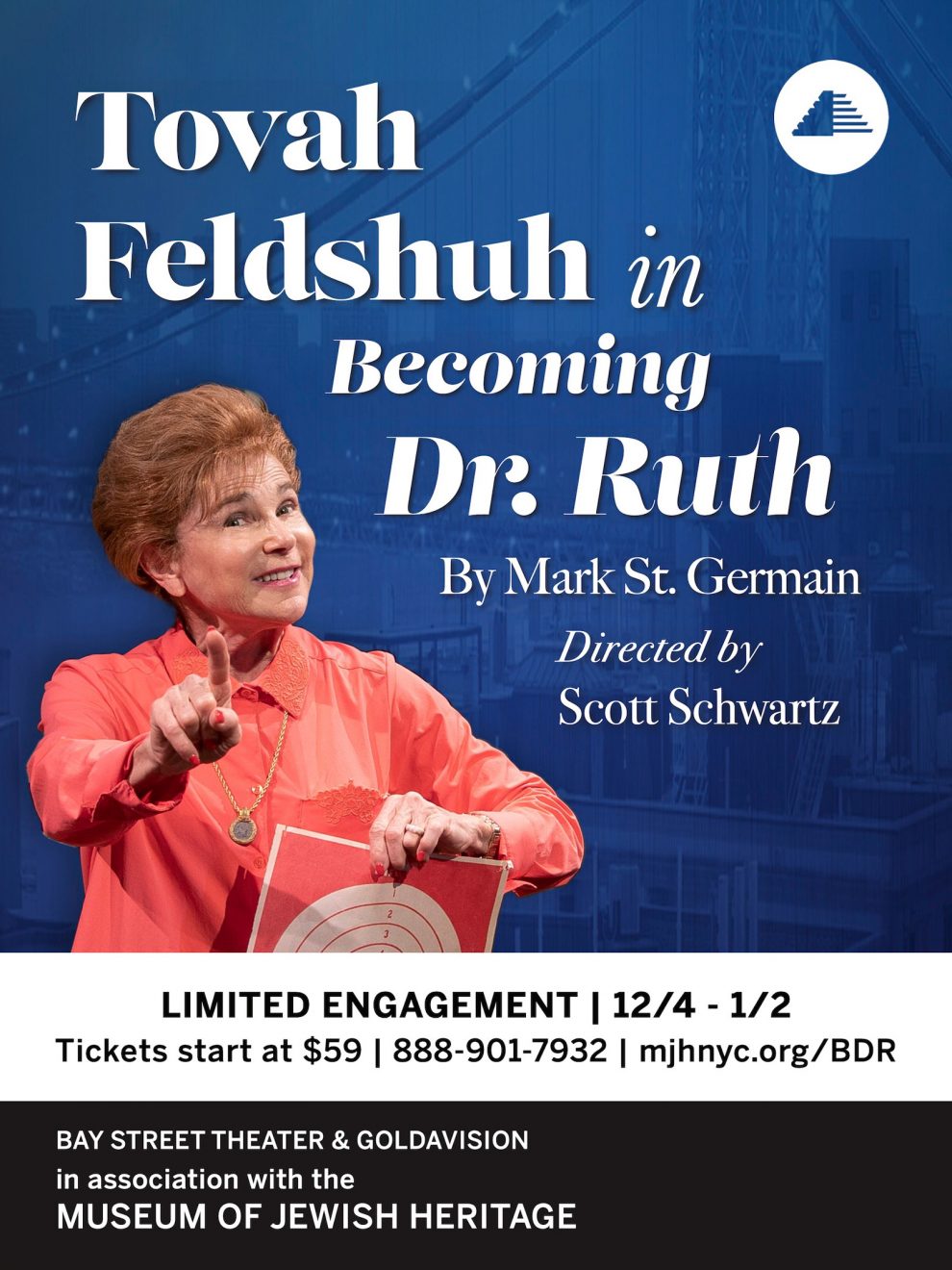
This December, award-winning actor Tovah Feldshuh returns to the stage in New York City for the first time in eight years, starring as Dr. Ruth Westheimer in “Becoming Dr. Ruth” at the Museum of Jewish Heritage – A Living Memorial to the Holocaust. Known for her roles on the stage and screen, she also recently published her memoir, “Lilyville: Mother, Daughter, and Other Roles I’ve Played.” Here she shared with us her thoughts and perspective on the show, her memoir, life, love and more.
What is this moment like as you prepare to perform in New York City again?
New York City is my hometown. It is a place that I love. It is a place that created my break in 1974 with “Yentl.” I am thrilled to return in person to the community in which I was born and the community that said, “We believe in you. You are worthy of a career on our stages.” I love playing all over the world and all over our country, but there’s nothing like coming home.
You get to portray one of the most universally beloved people, internationally-known sexologist Dr. Ruth Westheimer. What can audiences expect?
The most important thing to remember about Ruth is she chose not to burden us with her backstory. We know her as this brilliant, witty, funny, internationally-acclaimed sex therapist who brought sex from the darkness of the bedroom into the light of the living room. She came from the point of view that every human being (and probably every animal for that matter) is entitled to his or her orgasm and that sexual education is crucial to make this part of daily life. And that’s just the tip of the iceberg of what you will learn about Ruth. “Becoming Dr. Ruth” by the wonderful Mark St. Germain tells it all.
Regarding your memoir “Lilyville,” at what point did you think, “I have a great story to tell?”
A marvelous agent believed I had a writer’s voice. He quickly made a deal for me with one of the major publishers. If I were going to write a memoir, I wanted to plumb the depths of something universal, not just regale the reader with the little details of my little life. I had this extraordinary 65-year relationship with my mother that went from non-intimacy to intimacy, and I thought “Why not look at my life through my mother’s eyes and look at my mother’s life through mine?” The universal begins in the microcosm of the personal. I am hoping that “Lilyville” hits this universal for all mothers of all children and vice versa.
Did you initially plan this as a tribute to your mother?
No. I planned to take an in-depth look at the primal relationship of mother-child and its profound effect on both. Fortunately, Momma lived long enough (over 103) for us to work everything out and for me to appreciate “the gift of Lily.” In the end, her wisdom was remarkable, as was her generosity. The last thing she taught me was how to die. Witnessing her released me from the fear of death. What a gift that was!
What can others learn about the relationship between mothers and daughters from your experience?
I needed a mother who spoke the words, “I love you.” It took Lily decades to verbally initiate those words. I took her silence as the black hole of non-love. I compensated for her silence by going into the theater.
Your mother blossomed after your father, Sidney Feldshuh, passed away.
All her married life, Lily gave Sidney the spotlight. Then she lived 18 years past my father, and for those 18 years, she bloomed into the matriarch of the Kaplan-Feldshuh clan. She was a great, authentic listener and speaker. Finally, she started let these virtues out. With Sidney in the light, Lily didn’t have much room to shine. When he passed away, Lily was surprisingly hit by her own spotlight, and a family clamoring for her coronation.
Your husband, Andrew Levy, has a central role in the book – but you had six earlier marriage proposals. Why was this the offer you could not refuse?
For Andrew, it was truly okay for me never to leave my work. This was a man with enough space for both of us to shine.
And you also once turned down Warren Beatty.
I was flattered that Warren asked. I was at Cybil Shepherd’s and Peter Bogdonovich’s for one of those A-List Hollywood parties. Mr. Beatty invited me to be with him, and I said, “I’m sorry, I’m married.” He said, “So what?” I said, “So what for you! I have to wake up in the morning and go back to my life and life’s partner.” When I told that story to Patti LuPone, she said, “Tov, you missed a great one!”
The arts and cultural sector suffered immeasurably because of the pandemic. How did COVID-19 affect you?
I came home on February 22, 2020, from a big concert in Houston with my beloved musical director, and we both contracted COVID-19 by early March. I was stricken in the early days of the pandemic. We were not even sure what this was, but when I lost my sense of taste and smell — that was the red flag. Though depleted, I was not hospitalized. I took hot showers three times a day, consuming several huge bottles of Evian and continually did breathing exercises. Early this year, I had two Moderna shots, and just had my booster, flu shot, Shingrix and pneumonia vaccinations. I’m all shot up.
In “Lilyville,” you quote Mahatma Gandhi, “Live as if you were to die tomorrow, learn as if you were to live forever.” How does this reflect your approach to life?
The fear of extinction is epigenetically built into the body of the Jewish people. As a result, when you are living in your third act as I am now, you live life to the fullest. I live my vivid life in technicolor and climb the mountains of new experience now, while I can climb them.
This past summer, you stepped onto the stage at the Bay Street Theatre in Sag Harbor to sold-out audiences with “Becoming Dr. Ruth.” What was it like returning to live performances?
It was marvelous! Endorphins are released just be being around other human beings. You don’t need drugs. You don’t need liquor. You just need people. It was wonderful to impart this profound story to avid listeners who had such gratitude to be vaccinated, masked and back in the theater.
This December, you bring that performance to the Museum of Jewish Heritage. What do you hope the audience experiences?
The joy of all of us being together and the joy of celebrating a woman who came from extremely challenging circumstances and created a life of international contribution which led to her international fame.
Who else is on your bucket list to portray?
I always wanted to play St. Joan in a Black Box production, but the great woman I really want to play is my mother, Lillian Kaplan Feldshuh, who is the subject of my memoir. I am proud to say “Lilyville” has been optioned in Hollywood, and we hope to create a television series from the book.
What do you hope your legacy is?
I want to be known as a kind and giving heart, as a mother who loved unconditionally and a wife who loved devotedly. And finally, as an actress who thrived and gave back generously … and never gave up her dreams.


