


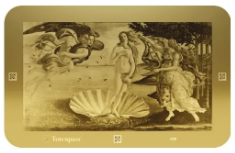
Totenpass is bringing back an ancient form of data storage that will carry on your legacy for thousands of years.
“Data storage is ephemeral,” said Bruce Ha, founder of Totenpass, “With hard drives lasting three to five years and memory cards lasting only 10 years, it’s becoming clearer that we can’t preserve our legacy on Dropbox.”
Ha, a Vietnamese immigrant, has been thinking about preserving his family’s legacy since the 1970s, when old family photographs suffered water damage during his family’s escape to America.
“As refugees from Vietnam, my family rushed so much that the only thing my mom took were the baby bottles and the photo albums of our family,” Ha explained. “During that time, our albums fell into the water and started degrading. I had a lot of trouble restoring them and thought that there must be a better way to preserve data.”
Before launching Totenpass, Ha had been engineering technology that could print a resolution of 25,000 dots per inch and was used to inscribe the entire Wikipedia, 30 million pages, onto a leaflet that weighed only eight grams. The leaflet was buried on the moon as part of a Lunar Library. Ha’s technology can precisely print thousands of words, pictures and other forms of data onto a page the size of a fingernail. With the idea of permanency in mind, Ha partnered with Roy Sebag, CEO of Goldmoney Inc., to use his technology to help consumers and businesses store their data in more efficient ways.
How It Works
Totenpass stores your data on a thin plate of nickel and gold the size of a credit card that lasts for centuries. USB drives, hard drives and cloud storage all run into the same problem: They don’t last long. Within several years, memories on your USB drive will start to fade away. With Totenpass, you can store entire family albums on a micro-level and pass them down to future generations. Ha’s technology of precise printing will transcribe all of your data perfectly.
And if you ever want to transfer your data from Totenpass to digital, you’ll be able to use the Totenpass reader, an optical reader that scans your Totenpass and uploads it as a digital file. The technology isn’t available yet, but Ha’s team is confident that a prototype will be out soon.
King Tut’s Gold Tablets
Ha’s technology was partly influenced by ancient kings, who used the most efficient forms of data storage to preserve their legacies without even knowing it. The word Totenpass is German for “the inscribed tablets or metal leaves found in burials.” Kings and other nobility would inscribe their legacies on gold tablets to be brought with them to their graves. The surviving tablets have literally lasted for thousands of years.
“King Tut’s collection of gold tablets from 2,000 years ago is still alive today,” Ha said. “So gold is the perfect medium for preservation. But we want to do that in a very high-tech way.”
The Key to Longevity
“The key to longevity on digital is to migrate from one platform to the next one,” Ha explained. “When you store data online, you trust these companies like Dropbox or Facebook, but these companies are storing your data on tapes and spinning disks, physical items that die. The Library of Congress uses these tapes because they can store a lot of information, but the drawback is that it must keep re-copying them onto other tapes so that the digital information is maintained. In that process, there is a deficiency, and it can lose information that way. Even for corporate conglomerates and major companies, there’s about one document lost every 12 seconds. So, there’s a difficulty in retention.”
Thomas Edison’s Prediction: Books on Nickel
By using gold and nickel to inscribe data, Totenpass creates storage that will outlive any form of digital medium. Gold and nickel are great for storing data because they are characteristically immune from common types of data destruction, like degradation or fire, and they last a very long time. In 1811, Thomas Edison predicted that books would one day be written on thin sheets of nickel because of nickel’s longevity.
“If you look in space, the visors of the astronauts are gold plated. All the foils are made of gold. It’s highly tolerant to heat and radiation. It’s highly conductive,” Ha said. “Nickel is used in alloys in marine ships and vehicles because it doesn’t rust. Propellers and things submerged in saltwater have nickel.”
Store Documents Forever
Preserving personal legacy is the focus of Totenpass, but Ha believes this technology will be used for other data storage too.
“My personal vision is to build a future where important information is never lost,” Ha said. “You look around in history, and libraries have been destroyed. Every time I see it, I’m distraught. We’ve lost so much valuable information over the millennia. I don’t think digital information will last for years. We’re looking way into the future, in a way that people can read the information years from now. We’re trying to store documents forever.”
Crypto Market
Totenpass is also venturing into the crypto-market. “In crypto, we see people putting their links, and they create cold wallets like that,” said Ha. “People have done wills, and those wills are legal documents. We’re looking at a lot of different applications, and we’re working on a focus group to look at even more applications.”
Shakespeare on One Card
Totenpasses are currently available in slates the size of credit cards and can store the entire works of Shakespeare all on one card. Other sizes are available for purchase upon request.
“For the price of lunch, you can store your data on a Totenpass and carry on your legacy for generations to come,” said Ha. “And that’s being stored without energy costs, in a decentralized way, and we do not touch consumers data. We’ve developed a way to create Totenpasses without ever being exposed to your data.”
For more information about Totenpass, please visit totenpass.com.


