


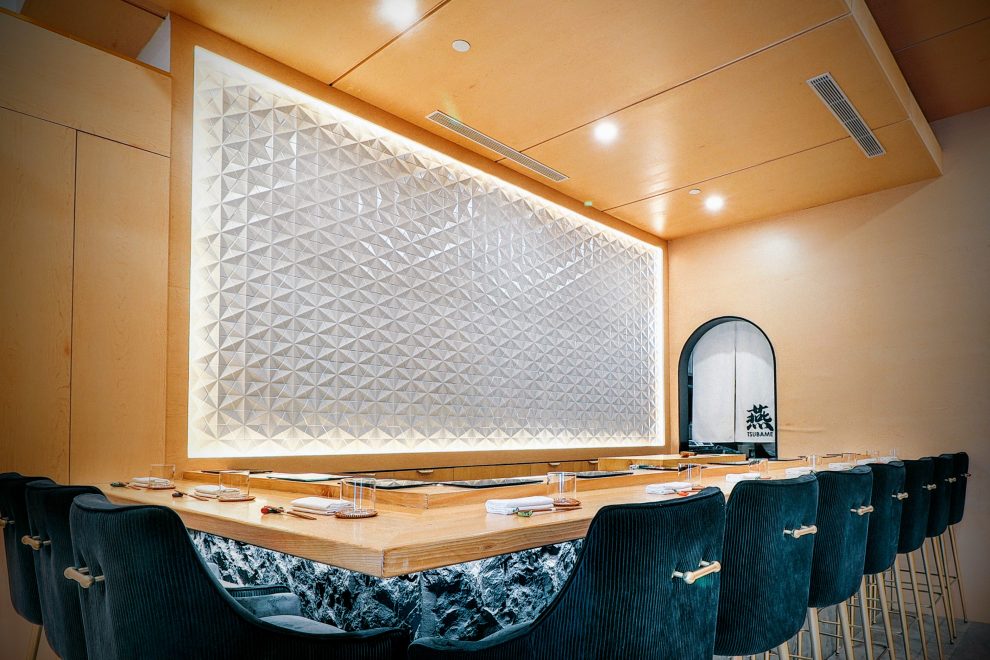
In Japan, “kaiseki” refers to a traditional multi-course meal, built around the finest seasonal ingredients. Many restaurants use this termi-nology in New York, but very few true kaiseki masters actually exist outside of Japan. For Tsubame, Chef/Owner Jay Zheng has created a kaiseki-inspired omakase experience to honor the rich traditions, but not to claim them as his own.
In classic kaiseki style, the menu is an ever chang-ing series of colorful assemblages made with the finest seasonal ingredients and fish, mainly sourced from Japan. His finished dishes reference Japanese classics but also touch broadly on his own roots and influences. Chef Zheng adds indulgent Western ingredients like caviar and truffles to the mix and displays an impressive array of techniques, but always avoids flash. In the Japanese manner, neglected by many of the omakase chefs who have popped up in NYC lately, Zheng lets the ingredients themselves shine. Born in rural China with frequent visits to Japan as a young man where he gained expansive Japanese cultural knowledge, Zheng and his family then mi-grated to the Midwest, where he grew up working in his family’s restaurants. He was educated as an engineer and tried the business world after college, but hospitality quickly drew him back. Stints at the Peninsula Hotel in Chicago hooked him on fine dining.
Chef Zheng opened his first Japanese fusion restau-rant in Indiana in 2012. Hoping for a more appre-ciative audience for real Japanese flavors, he moved to New York in 2016 and opened Gaijin, an upscale sushi restaurant in Astoria, Queens. After the pan-demic, he relaunched it as Kōyō, where he took over as Executive Chef and served his first kaiseki-in-spired tasting menus.
Always with his heart set on opening in Manhattan, he found the perfect location in Tribeca for his latest venture, Tsubame. Named for the barn swallow that nested in his childhood village in spring, the single, minimally decorated room is occupied entirely by the 10-seat chef’s counter. Like many kappo spots in Japan, Tsubame is very serious about the food, but less formal and more interactive, with Chef Zheng doing almost all the prepping and serving himself.
CUISINE: Tsubame offers an eight-course tast-ing progression, following a standard kaiseki for-mat. Varied culinary techniques and surprising combinations help bring out the natural flavors of beautiful seasonal ingredients. Combined, the ar-ray of bites produces a satisfying culinary journey that intrigues diners. Here are some descriptions of courses:
Sakizuke – the amuse-bouche – launches the meal. Chef Zheng’s Shiroebi Uni Shokupan is a big open-er, housemade milk bread layered with raw baby shrimp from Toyama and vivid uni from Hokkaido, garnished with shiso flowers. Luxuriously creative, it sets a tone for the meal that follows.
Hassun, meaning “eight inches,” is a collection of small bites served on miniature dining pedestals and marks the menu as an evocation of the season establishing Chef Zheng’s range as a chef. Eaten from right to left, the dishes are: Tako, Hokkaido octopus tentacle slow braised for four hours with daikon and served with wasabi, which is pure Japa-nese country; Caviar Shiso Potato Pave heaps rich briny Ossetra caviar atop a crispy scalloped potato and garnished with citrusy sansho pepper that gives the dish a Tokyo-meets-Paris sophistication; Toro Gobo Tart combines raw bluefin tuna, crisped gobo (burdock root) and torched rakkyo (pickled onion) in a rice paper wafer.
Yakimono, in a more traditional fashion, is a grilled fish course. Japanese Amadai (tilefish) is crisped yubiki style with hot oil before it is finished on a binchotan grill, served with house-made negi shoyu (green onion and soy sauce) over baby corn. The Mushimono that follows features Dungeness crab, and nagaimo (mountain yam), layered in an egg custard that is finished with a slurry of kudzu and shaved black truffles. It’s a worldly New Yorker’s take on Chawanmushi.
The entrée is Gohan, a rice course served in two different sets beginning with a nigiri progression and ending with a small rice bowl. For his nigiri, the chef favors a fluffy, lightly seasoned blend of two grains of koshihikari rice. Tsubame will serve sev-en to eight pieces of nigiri for each seating, which may include: ten day aged Shima aji (striped jack); Kinmedai (golden eye snapper) from Chiba; Barra-cuda from Kamasu; lightly cured Iwashi (sardine); Aji (horse mackerel) from Oita; Toro (tuna) from Spain; and Muki Hotate (scallop) from Miyagi. The proceeding rice bowl is composed of Uni from Hok-kaido and Ossetra caviar over koshihikari rice.
The experience concludes with Mizumono, two light seasonal desserts, and as it is customary to end a kaiseki meal with tea, Tsubame serves ceremoni-al Uji Matcha Green tea from Kyoto with seasonal fruit.


