


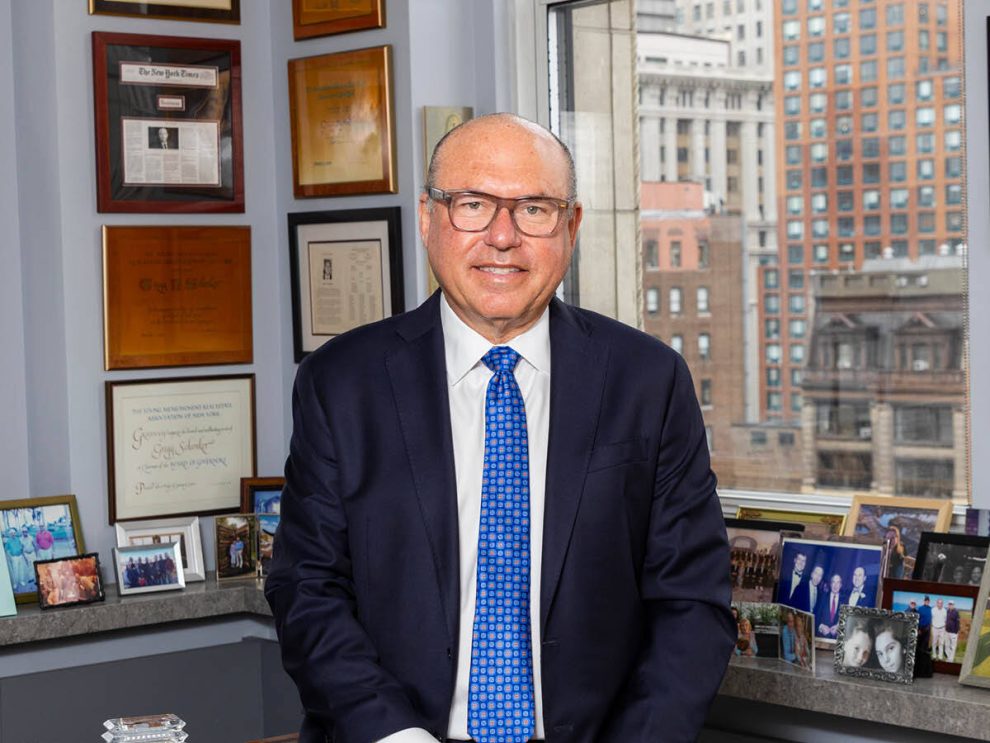
From his earliest days running a neighborhood business at 14 to co-founding one of New York City’s most respected real estate firms, Gregg Schenker has built a career—and a gratifying life—based on relentless work, uncompromising ethics, deep civic commitment and the quiet conviction that family is ultimately the most important thing he will ever build.
- • •
There are men who speak about hard work, and there are men who embody it. Gregg Schenker—founder, president and co-managing partner of ABS Partners Real Estate LLC—belongs firmly in the second category. Over more than three decades in New York real estate, he has built a reputation not simply for intelligence or dealmaking skill, but for consistency: of effort, judgment and values.
In an industry that often celebrates speed and swagger, Schenker has quietly built something more lasting. His career has been defined by seeking excellence, a strong ethical code, civic engagement and a long-view approach to business. At the same time, he and his wife, Lisa Baron Schenker, have built a family life on Manhattan’s Upper East Side centered on the same principles: responsibility, service and care for others.
His story did not begin in a boardroom. It began much earlier.
The Education of a Work Ethic
“The secret of getting ahead is getting started.” ― Mark Twain
At 14, Gregg Schenker was already running a neighborhood lawn-care business. What made it notable was not merely that he had customers but the way he approached the work. He took the time to understand what made a lawn healthy and green, which chemical products worked and how to deliver visible results. The business grew because the work was done well. Demand eventually exceeded what he could handle himself, thereby leading him to develop his earliest partnerships.
That initial success revealed a pattern that would define the rest of his life: he was never interested in doing something halfway. He wanted to understand the mechanics, master the details, and perform at a level that earned trust.
His parents reinforced that discipline. Work was expected, and so was structure. As Schenker puts it, he always worked, but he also tried to figure out how to work intelligently. That combination—effort plus thoughtfulness—became central to the way he approached every chapter that followed.
His father and grandfather were attorneys, and summers at his father’s law firm gave him an early education in professional standards. One of his assignments involved maintaining a Sanborn New York Land Map that had belonged to his grandfather. As buildings rose and zoning lots changed, Gregg updated the volume by hand, cutting and pasting revisions into the book. It was painstaking work, but it taught him to pay close attention to both the physical and legal fabric of the city. Today, he still keeps that book in his home library, complete with the pages he updated as a young man.
Even then, though, real estate—not law—was pulling at him. Looking up at the skyline, he wondered how buildings came together, how projects were financed and how owners turned ideas into structures that literally reshaped the city. His curiosity led to his desire to work with the people creating those great outcomes. With no family pipeline into the business, he decided he would find his own way in.
Learning the Business from the Ground Up
Before he was negotiating leases or advising owners, Schenker learned construction the direct way: on a job site. During two summers in college, he worked in Fort Greene, Brooklyn, for contractor Nick Russo as an assistant to the foreman. He moved through different trades and saw firsthand how a building is assembled—brickwork, framing, windows and the day-to-day realities that never appear in an investment memo.
That experience mattered. It gave him a practical understanding of buildings that many people in the business never acquire. He learned not just what could be drawn or budgeted, but what could actually be built.
He paired that hands-on education with formal study at the NYU Schack Institute of Real Estate, attending classes at night while working during the day. The program exposed him to leading practitioners, including figures such as Stephen Ross and Larry Silverstein. Years later, he endowed a scholarship at NYU Schack, with the intention of increasing it over time so that others may also realize their full potential.
Like many lifelong New Yorkers, Schenker also carries a deeply personal memory of September 11, 2001. Standing with Lisa and watching the skyline change in real time remains one of the defining moments of his life. The devastation was almost impossible to comprehend. Yet for him, the years that followed also reinforced something essential about New York: the city’s refusal to stay down. The city’s ability to rebuild against the greatest odds has mirrored the qualities he most respects in both institutions and people.
Helmsley Spear and the Making of a Professional
Schenker’s entry into major real estate came through Helmsley Spear—then one of the largest privately held real estate companies in the country. When he applied, he framed his ambition in direct terms: he wanted to learn the industry well enough that both he and others would regard him as a true professional. Money, in his view, was a mere byproduct of becoming truly capable.
At Helmsley, he developed exactly that reputation. One early moment became emblematic. While working on a project for Stephen Green, Schenker ran detailed calculations by hand at the same time that others were using a new computer model in Lotus. His longhand work matched the computerized results. It was a memorable proof point: diligence, patience and accuracy mattered, and he was prepared to do all of the work necessary to earn confidence.
The most important relationship for Gregg was his mentorship under Earle Altman, the legendary head of Helmsley’s sales and leasing divisions. Altman did more than supervise him; importantly, he challenged him to stretch. When a lobby renovation was estimated externally at $250,000, Altman asked Schenker what he thought it should cost. Schenker said closer to $50,000. Altman’s response was simple: then go build it. Despite his protests that he had never done such a thing, Altman told him that he was more capable than he realized. With that, Schenker successfully designed and built the lobby.
That kind of trust was formative. It reinforced Schenker’s belief that real growth comes from responsibility accepted before comfort arrives. It also sharpened a professional identity that would define him for decades: serious, prepared, detail-oriented and not interested in shortcuts.
Early Leadership and a Commitment to Service
By his late twenties, Schenker was already being asked to lead. He became chairman of the board of ARMI—the Association for the Rehabilitation of the Mentally Ill—a nonprofit focused on supportive housing and homelessness prevention for vulnerable New Yorkers. During his tenure which lasted more than a decade, the organization evolved from scattered-site housing to the development of two ground-up buildings in Manhattan, created specifically to support New Yorkers in need
The work mattered to him because it addressed dignity as well as shelter. Housing is never merely physical. It affects stability, identity, health and the possibility of community. One of the projects developed during his time as chair was designed around the idea that social connection itself is part of healing.
His civic commitments extended well beyond housing. He served for roughly 20 years as chair of the Real Estate Council of Carnegie Hall and also joined the Board of the Real Estate and Construction Council of Lincoln Center. These roles reflected one of his enduring convictions: that the arts are not just ornamental to a city like New York; they are part of its identity.
Founding ABS Partners
After the death of Harry Helmsley and retirement of Alvin Schwartz, the chapter that had defined Helmsley Spear came to an end. In 1999, Schenker, Earle Altman, Steven Hornstock, Daniel Burack and Peter Burack co-founded ABS Partners Real Estate LLC. The name came from the founders’ initials, a fitting reflection of the firm’s character: it was built around people and reputation more than around branding.
The new venture began with immediate credibility because the principals had already established themselves in the market. Even so, Schenker is clear that ABS was not an overnight success story in the usual sense. It grew steadily and deliberately. That pace was not a weakness; it was a philosophy. The firm was built to last and forge long-standing partnerships, not to chase quick wins.
Under Schenker and his partners, ABS developed a reputation for handling complex assignments for owners, organizing investment ventures and advising families with generational holdings. The firm’s business spans leasing, sales advisory, investment ownership, asset management and strategic consulting. Across those categories, certain principles have remained constant: long-term thinking, conservative use of leverage and the importance of maintaining well-capitalized enterprises.
The Flatiron Neighborhood and Stewardship
One of Schenker’s more notable early moves was helping negotiate to acquire an interest in the Flatiron Building, one of New York’s most iconic landmarks. The stake may have been economically modest, but it carried meaningful influence over major decisions involving the property. The original intent was not to flip the investment, but to increase ownership over time.
The ownership years ultimately became more difficult, especially during the pandemic, when stress and diverging views among partners made consensus harder to achieve. Yet the Flatiron chapter also deepened Schenker’s civic involvement in the neighborhood. He became a founding member and served as chairman for more than a decade of the Flatiron Business Improvement District (BID) and also served on the board of the Union Square Partnership for a decade—during a period when both districts were evolving into two of Manhattan’s most energetic commercial and cultural corridors
These roles reveal an important aspect of Schenker’s perspective. He does not see real estate simply as an asset class. He sees people as vital to progress, and neighborhoods as ecosystems that require stewardship, collaboration and long-term attention.
Recognition from His Peers
In a competitive business, the honors that have mattered most to Schenker are the ones bestowed by peers—people who understand exactly how difficult it is to do this work well and ethically over a long period of time.
In 2008, he received the Young Real Estate Man of the Year Award at the Real Estate Board of New York’s (REBNY) annual banquet. In 2012, the Flatiron 23rd Street BID honored him with its Community Service Award. In 2019, the Young Men’s/Women’s Real Estate Association (YM/WREA) named him Senior Professional of the Year. The Madison Square Park Conservancy presented Schenker with the Madison Square Award in 2015, in recognition of his support and commitment to Madison Square Park.
In 2021, at REBNY’s 125th Annual Banquet, Schenker received the Louis Smadbeck Memorial Broker Recognition Award, an honor associated with personal and professional integrity, leadership and standing within the brokerage community.
Then, in 2025, Schenker and his ABS partners Randy Modell and Steven Hornstock received REBNY’s first-place Henry Hart Rice Achievement Award for the sale of 1450 Third Avenue. The deal was extraordinary for both its complexity and creativity: splitting a residential building in two while remaining occupied.
Home, Family and the Measure of Success
In 1993, Gregg Schenker married Lisa Baron Schenker. More than three decades later, he speaks about her with admiration and gratitude. He describes her as one of the kindest people he knows—not performatively kind but genuinely oriented towards helping others.
That spirit is reflected in her volunteer work with the Evelyn Alexander Wildlife Foundation, where she serves as a board member and wildlife rescue responder. The work demands patience, toughness and emotional resilience. It also tells you something about the values that shape the family’s life away from business.
Together, Gregg and Lisa raised two daughters, Emma and Olivia, in New York City. Both attended Madison Avenue Presbyterian Day School and later Columbia Grammar and Preparatory School. Emma graduated from Connecticut College and earned a master’s degree from Bank Street College of Education. She is now a first-grade teacher at the Ethical Culture School, helping children better understand the world around them. Olivia graduated from Northwestern University with a degree in Environmental Studies and Environmental Policy, choosing a path oriented toward the future.
For Schenker, these are not incidental accomplishments. They are central. When he speaks about his greatest achievement, he does not point first to a building, a transaction or an award. He points to his daughters and to the character they developed growing up amid all the distractions and intensity of New York. He is quick to credit Lisa for much of that outcome.
Outside the office, he reads widely—his varied interests include history and poetry, and Schenker often refers to the great quotations that have influenced his thinking. He also sails, listens to music, collects contemporary art and values communities that provide intellectually stimulating conversation.
Ethics Under Pressure
“Character, courage and strength come through at the highest point of adversity.” — Gregg Schenker
For Schenker, principles mean little if they disappear under stress, the truest test of resiliency. The pandemic offered a severe test of that belief. COVID reshaped New York real estate overnight, putting extraordinary pressure on owners, tenants, lenders, investors and brokers.
At ABS, Schenker says, the ethical standards of the firm did not bend regardless of the pandemic’s many challenges. The team looked for practical, creative ways to help tenants and keep buildings functioning. The steadfast, underlying philosophy was simple: everyone involved is part of the same community.
One of the clearest examples of strength under pressure was 270 Madison Avenue. The building had become deeply troubled, with vacancy approaching 60% and another 20% of tenants not paying rent. Instead of walking away from the problem or looking for an easy way out, ABS doubled down in its efforts, and with its partners reinvested and rebuilt, using their own in-house design build team. By rethinking interiors creatively, salvaging useful systems while improving others, and leaning on long-developed market relationships, the firm repositioned the property at a cost far below conventional expectations. Within nine months, it was substantially leased.
Schenker sees that turnaround not just as a business success but as proof that long-term credibility matters. People trusted ABS because the firm had that track record, spending years behaving in a trustworthy way.
Giving Back to New York
Schenker’s civic record is not a side note to his career, it is woven into it. His leadership at ARMI, Carnegie Hall, Lincoln Center, the Flatiron BID, the Union Square Partnership, REBNY and the YM/WREA reflects a longstanding commitment to helping sustain the institutions and neighborhoods that make New York what it is.
He is also deeply invested in mentoring younger professionals, a commitment that shows up both informally and institutionally. He has made significant financial contributions to the New York Junior Tennis and Learning program, an organization which mentors young people. And through his NYU Schack scholarship, he has created a direct bridge between his own early years—working during the day, studying at night, trying to earn credibility—and the students now trying to do the same.
Mentorship, in his view, is not a one-way act. Experience matters but so does openness to the next generation’s perspective, especially in a world being reshaped by technology.
The Next Chapter
ABS remains active and ambitious, but Schenker is also focused on what comes next. The firm continues to grow organically while applying lessons learned from earlier cycles, including mistakes made before the pandemic. One major priority is continuing to upgrade the firm’s technological capacities and invest in its team, hiring and retaining the best people. For example, the firm is developing a streamlined proprietary software platform aimed at unifying tools used by tenants, employees, investors, vendors and other stakeholders.
As he turns 60, he is not preoccupied with summing up the past. Instead, he is focused on what he may still be able to build. Watching mentor Earle Altman during the decades between 60 and 80 left a deep impression on him. Those years, he observed, can be among the most productive of a professional life because experience, relationships and judgment have fully converged.
Schenker hopes the same will be true for him. He wants ABS to realize more of its potential through the strength of its team and to leave behind a company known above all for its values, work ethic and integrity. He also wants to be remembered more simply: as someone who cared, worked hard, kept trying and understood that failure is a natural part of growth.
The lawn-care business at 14, the hand-updated land map, the construction work in Brooklyn, the night classes, the mentorship under Earle Altman, the nonprofit leadership, the iconic buildings, the awards, the scholarship and the gratifying family life all point back to the same beliefs: Work matters. Character matters. Service matters. And success means little if it is not built in a way that lets you respect yourself when the day is done.
For all that he has accomplished, Schenker still speaks with the energy of someone who feels there is more to do. He loves the act of building in real estate because, unlike in many fields, the results are tangible, visible. You can look at what was imagined, worked for, negotiated, repaired or revived—and is standing there for all the world to see.
Gregg Schenker has spent decades building visible things in New York City. But beneath them all is an invisible framework that matters even more: integrity, persistence, discipline and devotion to the people, communities and institutions that make life truly meaningful.
“There is nothing noble in being superior to your fellow man; true nobility is being superior to your former self.” ― Ernest Hemingway
ABS Partners Real Estate LLC – New York City – Est. 1999


