


Long before abstraction became fashionable within contemporary interiors and art fairs, color functioned as something closer to theology.
Byzantine icon painters understood pigment as spiritual threshold. Mark Rothko sought emotional devastation through chromatic fields alone. Wassily Kandinsky believed color could bypass language entirely and strike directly at the soul. Even Hilma af Klint, decades before the market could properly understand her, approached painting less as composition than transmission, allowing intuition and unseen psychic movement to guide the image before logic intervened.
Karina Lumière works within that lineage of surrender.
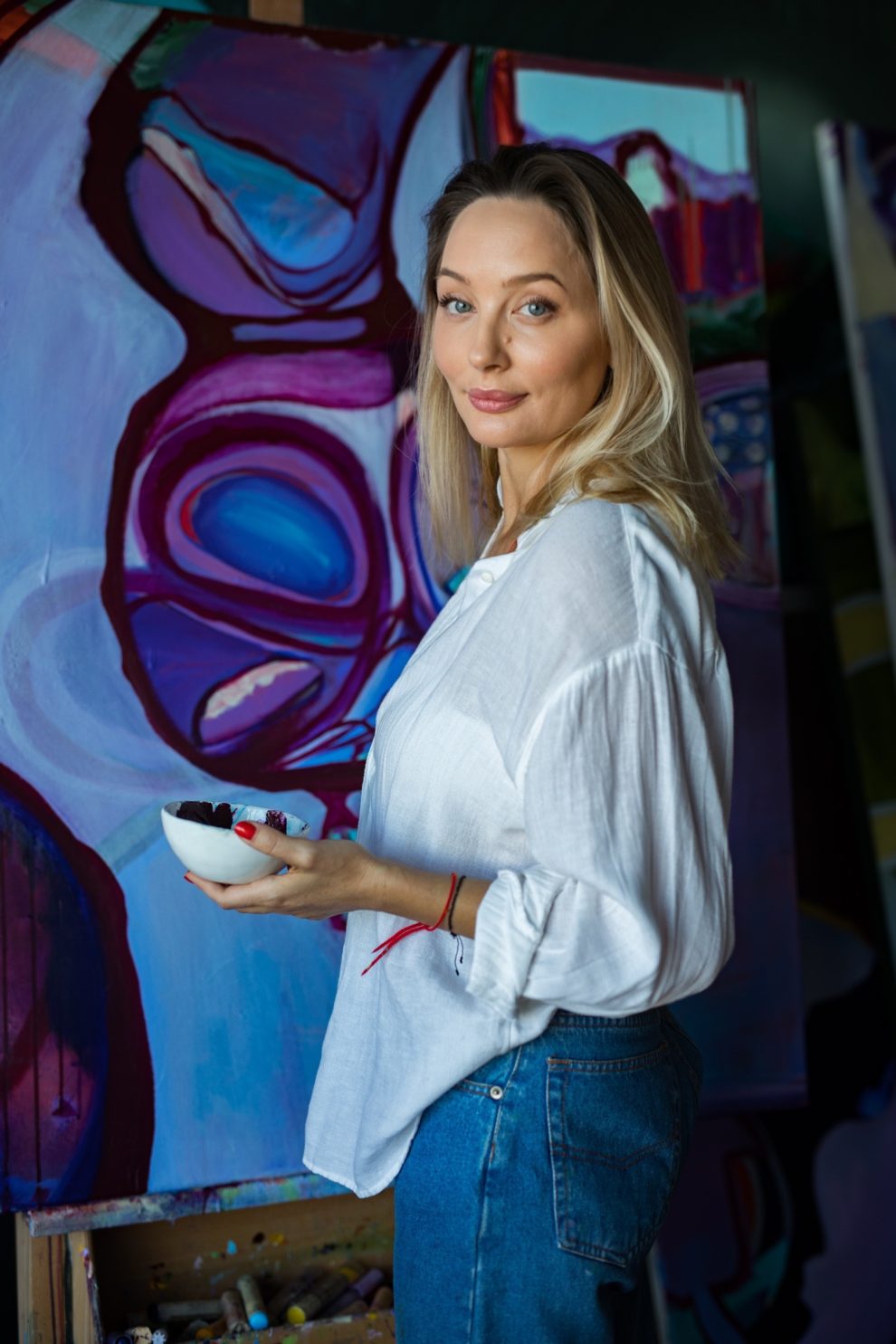
The internationally based artist does not begin with a fixed image in mind. Their work is developed under AA Luxury Atelier, including an upcoming New York solo exhibition this September and a Miami debut during Art Week in December. There is no rigid premeditation, no overly resolved blueprint dictating outcome before the brush ever touches surface. Instead, her paintings emerge through emotional excavation, unfolding instinctively layer by layer until the work reveals its own internal logic.
That instinctual process is visible immediately.
Within Lumière’s compositions, bodies dissolve into atmosphere, cellular structures bloom against dreamlike passages of lavender and bruised violet, vascular lines coil through fields of saturated pink, while pale silhouettes hover somewhere between apparition and anatomy. At moments, the paintings feel almost embryonic, as though consciousness itself were still forming inside the canvas. Elsewhere, they evoke underwater kingdoms, cosmic cartographies or psychic interiors impossible to fully name.
Yet what ultimately anchors the work is color.
For Lumière, color is not embellishment. It is communication itself.
Powder blue floods through the paintings like suspended breath. Dense purples pulse with something simultaneously sensual and wounded. Acidic flashes of green rupture softer passages like emotional intrusion. Pearlescent whites scatter across the surface like fragments of memory, cellular division or distant stars viewed through water. The paintings seem to speak through chromatic tension before the viewer has time to intellectually organize what they are seeing.
This is where the work becomes deeply psychological.
Her paintings resist passive viewing because they do not behave as static images. They move emotionally. One senses vulnerability and concealment existing simultaneously inside the same composition. Human forms appear only partially articulated, often dissolving into surrounding environments as though identity itself were in flux. The result is a body of work that feels less painted than unearthed.
Perhaps unsurprisingly, this approach aligns powerfully with a contemporary moment increasingly exhausted by overexplanation. Lumière leaves room for uncertainty. The viewer is not instructed how to feel. Instead, one enters the work intuitively, emotionally, almost physically.
That quality will likely become central to the artist’s upcoming New York solo exhibition this September, which is being conceived not as a conventional gallery presentation but as a salon-style encounter emphasizing intimacy, proximity and emotional immersion. The exhibition, developed through AA Luxury Atelier, will position Lumière’s paintings within a more residential and collector-centered environment, allowing the work to breathe within lived space rather than sterile spectacle.
That distinction matters.
Collectors today increasingly seek experiences that feel psychologically resonant rather than performative. The return of the salon, the townhouse exhibition, the private dinner and the immersive viewing environment reflects a larger cultural shift away from overstimulation and toward intimacy. Lumière’s paintings seem uniquely suited to that atmosphere because they already function like emotional interiors themselves.
By December, the trajectory expands further with Lumière’s Miami debut during the early VIP days of Miami Art Week, before the official opening of Art Basel Miami Beach. The timing is intentional. It places the work before collectors while the city still retains a degree of quiet concentration, prior to the saturation and noise that inevitably follows.
In many ways, the strategy surrounding Lumière mirrors the paintings themselves: intuitive yet controlled, atmospheric yet exacting, emotionally expansive while refusing excess. There is patience in the pacing. Trust in gradual revelation.
Her paintings do not arrive fully explained. They arrive alive.
By Avalon Ashley Bellos
Avalonashley.com


