


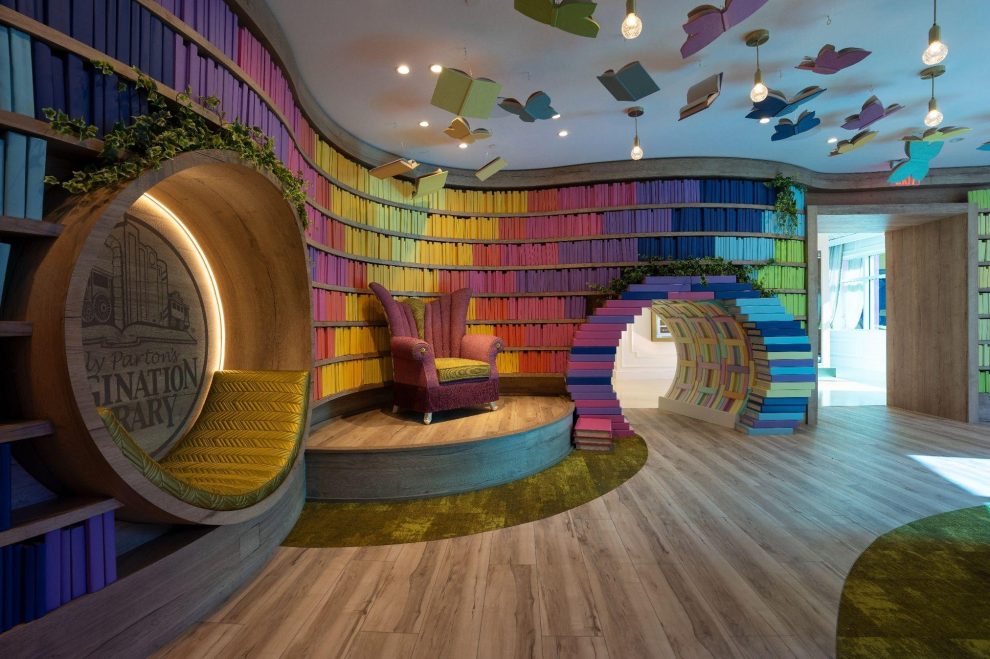
As Dolly Parton’s SongTeller Hotel and Dolly’s Life of Many Colors Museum officially open in Nashville, AOA, the award-winning design, production and project management studio behind the museum’s immersive experience, is sharing an inside look at the two-year journey to bring Dolly Parton’s story to life—from their first concept sketches through opening day.
AOA served as the sole creative and production partner behind Dolly’s Life of Many Colors Museum, leading the collaboration with Dolly Parton and her family from concept through opening day delivery. The museum’s design and curation were led by Dolly’s niece and museum Executive Director Rebecca Seaver, Dolly’s sister Rachel Parton George, and Dolly’s Creative Director and Costume Designer Steve Summers, who collaborated closely with the AOA team throughout the design process. Dolly and her family led the story, and AOA dreamt and built the physical world around it.
“When Dolly Parton and her family reached out to us, we knew we wanted to be in the room with her. Our team has long admired who she is and everything she has done, and working alongside her and her team gave us a chance to discover parts of her life and her history that we’d never known,” said Tom Acomb, chief creative executive and co-founder of AOA. “We started with a napkin sketch and a lot of blank paper, but we brought the lessons learned from dozens of projects to the table so she could tell her story in her own voice.”
That story, in most museum settings, comes to life via physical artifacts, with supporting roles provided by graphics and media. Under AOA’s creative stewardship, Dolly’s artifacts (of which the museum has more than 300), decades of archival media and the physical environments themselves are woven together by Dolly’s autobiographical narration, creating a cohesive performance in which all elements work collaboratively to tell Dolly’s story. AOA also brought in all the technological tools as a full suite to apply toward the story as it developed.
Spanning the entirety of the hotel’s third floor at more than 20,000 square feet, the museum takes guests on Dolly’s journey “from the top of the mountains to the top of the world”—from a recreation of the small cabin where she was born in the Great Smoky Mountains, through her earliest days in Nashville, her rise on television and film, the founding of Dollywood and decades of philanthropy and global influence.
“It is important to the guest journey that each exhibit feels like the moment it’s representing in Dolly’s life while also ensuring a seamless experience,” said Juliana-Marie “JAM” Troyan, producer at AOA. “To strike this balance, our team was intentional in all aspects of design, from color palettes and textures to the fonts on signs and the distant instruments guests hear in background music.”
The project’s greatest design challenge came before a single finish was chosen: the museum’s 20,000 square feet weren’t purpose-built, but carved from the third floor of what began as an office tower before its conversion into Dolly Parton’s SongTeller Hotel. AOA led the project across its full lifecycle—concept design and development, architecture, interior design, graphic design, media design and production, mockups and prototypes, previsualization, scenic paint and fabrication, show set design, technical direction and integration, project management and construction oversight—working alongside trusted fabrication and technical partners to translate more than 20 distinct themed environments into a single, continuous walk-through experience, with material, color and texture shifting from room to room to mark each chapter of Dolly’s story.
That storytelling shows up in the museum’s smallest details as much as its largest gestures: a recreation of the Wishy Washy, the real laundromat where Dolly met her late husband Carl Dean, pairs an animated retelling of their meeting with her actual wedding dress, on public display for the first time. Elsewhere, AOA’s scenic painters translated vistas from Dolly’s Tennessee Mountain Home into a front-porch mural that envelops the museum’s recreation.
“We didn’t want to build a museum that felt like a museum. With the focus being one of the most dazzling and decorated careers in entertainment, we wanted guests to feel like they were walking through Dolly’s actual memories as she would have remembered them. This space had to feel visceral, glamorous, saturated and as varied in texture and material as the life Dolly lived,” said Erin McCollum, principal concept designer and creative lead at AOA. “Every creative decision came back to that idea—each exhibit acts as an immersive, unique patch on the coat of Dolly’s life.”
The experience closes with an original piece of technology developed specifically for the museum: a virtual performance, where guests can experience Dolly on stage. Her performance is perspective-corrected and lit to match the room in real time, so that the line between the physical and digital spaces all but disappears. It’s one of several technologies—including a centralized show-control system that synchronizes audio, video, lighting and interactive media throughout the museum, and a hands-free assistive-listening system offering personalized audio and multilingual captioning—that give the museum the pacing and atmosphere of an immersive entertainment experience rather than a traditional exhibition hall.
“We had to make sure nothing about the technology got in the way of the connection between Dolly and her audience,” said Jeff DeBoer, art director at AOA. “Dolly’s music was part of my childhood before it was ever part of my career, so getting to help bring her back on stage, one more time, for everyone who walks through that room is not something I’ll ever take for granted.”
Behind the scenes, the project was built on the same business discipline Dolly herself was known for. AOA delivered the museum, managing its schedule and budget while balancing creative ambitions with the feasibility studies and projected-visitation modeling required to bring a project of this scale to life. That same care extended to two dedicated shopping experiences, woven into the guest journey from the very beginning, designed to feel like a natural extension of Dolly’s story rather than a stop along the way.
“Every schedule, every budget line, every design decision had to serve the same goal: telling Dolly’s story with the same honesty and integrity as Dolly herself,” said Shannon Mashchak, principal project manager at AOA. “Managing this project to ensure it came together across so many disciplines, vendors and hands was made even more meaningful by getting to do it alongside such a talented team, and being able to preserve a legacy through physical space.”
“Dolly approached this project the way she’s approached everything in her career—with heart, but also with real work ethic and focus,” said Mike Ostendorf, CEO and co-founder of AOA. “Our job was to match that: to build something emotionally unforgettable that was also delivered on time, on budget and built to last. I’m incredibly proud of what this team accomplished.”
Alongside the museum, AOA’s project management team under the leadership of Savannah Wexler, general manager of AOA Tennessee and senior project manager, supported the broader vision for Dolly Parton’s SongTeller Hotel, a 240-room property created in partnership with Dolly Parton and Herschend. As the project’s owner’s representative, the team ensured Dolly’s storytelling spirit carries through the guest experience beyond the museum’s walls and into the hotel that houses it.


