


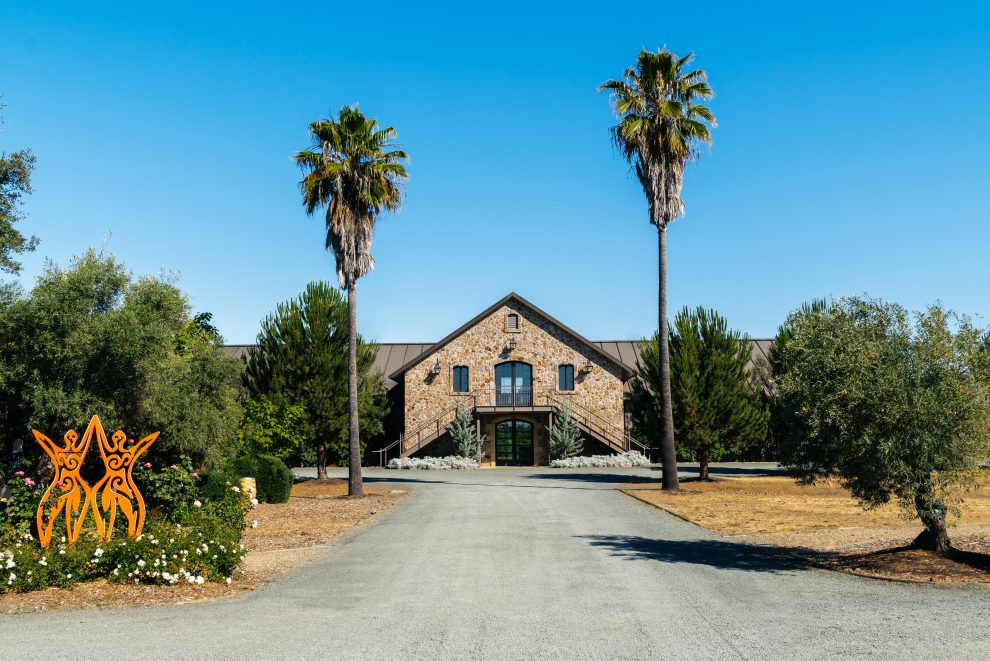
Nestled amidst one of Napa Valley’s oldest vineyards, tracing its grape cultivation roots back to 1871, Crocker & Starr (CS) has been crafting exceptional wines for over 26 years. Executive Vice President Cyrus Hazzard unveils the secrets behind their winemaking excellence.
As a small business, how important is a good team?
The team means SO much! Everyone plays a critical role – and not just one role. On any given day, you would see the hospitality team helping out in the winery, and the winemaking team stopping in to say hello to the guests visiting. [We have] a cohesive team that looks for the details, and understands that while each person has a specific expertise, everyone is looking out for each other.
When opening, what steps did CS take to become more sustainable than its competitors?
We started with a conventionally farmed vineyard back in 1997. Pam Starr and Charlie Crocker immediately started taking steps to farm the vineyard organically. Over the years it has been of utmost importance to continue to become greener and to farm sustainably. We are always looking for ways to take care of the land. In the winery we implemented technology that would reduce our carbon footprint and preserve our natural resources. Just this year we took it a step further and installed solar on the winery, intending to become more carbon neutral.
How has CS changed over the years?
In the beginning, it was just Pam and Charlie, with 100 cases of Cabernet Franc. Now we are a small (but mighty!) team of nine that produces 4,500 cases annually. Back in 1997, our wine was only sold to great restaurants around the San Francisco Bay Area and the greater Los Angeles market. As the years went by and our production grew, we started hosting guests at the estate in St. Helena.
The response was so amazing – people traveled all over the country just to come to taste our wines! The Casali Membership was created due to that incredible demand and is now the only way to get access to many of our wines.
How does CS harvest its grapes?
Everything is harvested by hand. Most of the grapes are picked into small boxes – holding roughly 30 pounds of grapes. This ensures the grape clusters come into the winery in pristine condition – no broken skins or crushed clusters. They are then carefully sorted onto an elevator to remove any small leaves and sticks that may have accidentally made it into the bin when picked. From there, clusters go through a de-stemmer, which separates the grapes from the stems, sending the single grapes onto a sorting table. On that table yet another pass is made by hand to remove stem jacks and imperfect grapes before they are put into the vessel it is destined to be fermented in. Then the sugar in the grapes and yeast work together to make wine!
How long is this process? Do you have people who specialize in this?
This process varies by the grape variety and volume that is harvested. Typically harvest starts in August, and all the grapes are in before the end of October. The winemaking process is much longer than that, though. Red wine is made and then aged in barrels for 18-20 months before bottling. Once bottled, they will rest for one year before releasing the membership. There are people who specialize in this; the winemaking team here at Crocker & Starr consists of Julie Robertson as winemaker, Pam Starr as consulting winemaker and Addie Dearden as production Enologist.
What is CS’ most popular wine?
The first wine produced, Estate Cabernet Franc, is still our most sought-after. It is our Winter Membership wine, and it sells out upon release. I wish we could produce more – but the vineyard only gives us so much! We make incredible Cabernet Sauvignon and Sauvignon Blanc, too. And for something much more unique, Malbec has become increasingly more popular amongst our fans.
How does CS differ from neighboring vineyards?
Our goal is to ensure the land will continue to produce great grapes for generations to come. We use electric tractors to reduce our carbon footprint. In the spring, sheep eat our cover crop. Bird boxes that house owls naturally control our animal ecosystem. All of these things are leading us down a path of regenerative farming, which is the next evolution beyond organic farming.
How do you apply your philosophy to wine-making?
We look to harness the essence of our unique property – and that starts with planting the right grape varieties in the right soils, in the right parts of the vineyard. Then, it’s all about letting those incredible vines produce grapes of the highest quality. Winemaking is a combination of art and science – for us it is about the transformation from vineyard to bottle, wines true to their place of origin. Opening a bottle of Crocker & Starr should transport you back to the Crocker Estate with every sniff and every sip.
Can you talk a bit about Carnivus Maximus?
It’s the GRANDEST Party in Napa! Our annual celebration on the Sunday before Labor Day is filled with live music, outrageously fun games, an amazing bounty of food and of course delicious wine! We pour current releases along with large-format library wines to celebrate the new harvest. This event books up fast so if you’re planning on coming book your hotels and tickets well ahead of time.


