


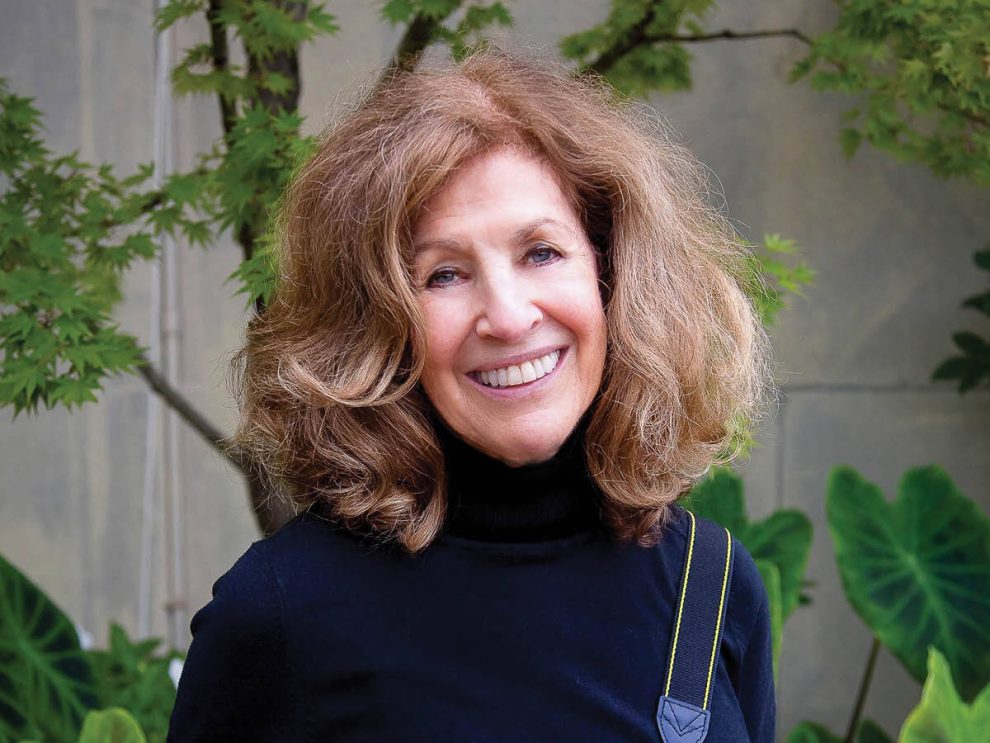
Judy Glickman Lauder has spent a lifetime looking closely at the world through the lens of a camera. She has achieved a rare distinction as both a renowned photographer whose work is in major collections, including the Metropolitan Museum of Art and the Whitney Museum of American Art, and also as a prolific collector with over 700 images by legends like Sebastião Salgado, Margaret Bourke-White and Henri Cartier-Bresson. As both photographer and collector, she has devoted herself to preserving human stories, embodied by a deep sense of empathy, historical awareness and faith in photography’s power to record human experience. Also an author, philanthropist, humanitarian and activist, one major facet of Glickman Lauder’s own photographic work has been the Holocaust.
Southampton Arts Center: AFA Touring Exhibition
Her dynamic, pensive collection is currently being explored at Southampton Arts Center in the exhibition, “Presence: The Photography Collection of Judy Glickman Lauder,” up through September 27. Each image in the show represents a human presence. “It’s a human spirit, so there’s not a lot of landscape or abstract,” Glickman Lauder said. Comprising over 100 images by 50 different artists, including some of her own, the exhibit is arranged into eight thematic sections, from social documentary to Surrealism to street photography, all signifying the idea of presence. Curated by Anjuli Lebowitz, the Judy Glickman Lauder curator of photography at the Portland Museum of Art in Maine, and co-organized by the American Federation of Arts (AFA), the exhibit will travel to Sarasota, Florida; Charleston, South Carolina, and Miami, Florida. Accompanying the meditative show, Glickman Lauder has recently published “Presence,” a book that covers her collection, including hundreds of photographs not included in the exhibition. “It’s been fun but daunting to narrow down which pictures would be included in both the exhibit and the book. AFA is an incredible organization, bringing so many art forms all over the nation,” Glickman Lauder said. “The people I have worked with are really good, and the Southampton Arts Center did a super job. And so I’m thrilled about it.” The Delicacies of Representing Atrocity Glickman Lauder considers her work dealing with the Holocaust, and specifically the Danish rescue of Jews during WWII, a defining feature of her photography career. Active in Jewish causes, she once took the opportunity for a two-day visit to Auschwitz and Birkenau on the way to Israel. “Being there and seeing the evidence of what happened really turned me all around,” she said. Though she was born in California, Glickman Lauder’s family was from Lithuania, Poland and Ukraine, where 90% of Jewish individuals were killed during World War II. She said, “I realized when I went to those camps that probably many of my family had perished there. And that became kind of a mission.”
The Danish Rescue
Over a three-year period, she returned to the Holocaust sites, photographing at eight different concentration camps, the railroad tracks, the crematoriums, the memorials, the areas of cities where there previously had been large Jewish ghettos. Based on that body of work, Glickman Lauder was invited to go to Denmark in 1990 to try to put together an exhibit commemorating the 50th anniversary of the Danish rescue, which took place in 1943. In Denmark, she was able to contact survivors who gave her names and addresses of rescuers. “I was on actual fishing boats that crossed over the sound from Denmark to Sweden, because by ’43, Sweden was willing to risk its neutrality and allow the Jewish population to come in,” Glickman Lauder said. “And it’s just an amazing story of both countries. I have a book called ‘Beyond the Shadows,’ which tells the story of both the Holocaust and the Danish rescue. Everyone needs to know that story, especially in today’s world because man can make a difference and man can retain humanity in difficult times.” The book includes texts by Holocaust scholars, Jewish Danish survivors and an original piece by Elie Wiesel, author of the world-renowned memoir “Night,” who had seen Glickman Lauder’s work.
A Wide-reaching Body of Work
Glickman Lauder has held over 200 exhibits of her body of work at universities, libraries, museums, temples and churches all over the world. In addition to major museums like the Getty, her work is in the permanent collections of the Museum of the Martyrs in Paris, the United States Holocaust Memorial Museum in D.C., the Jewish Museum in New York, The Israel Museum and Yad Vashem in Jerusalem, the Los Angeles Museum of the Holocaust, the Danish Jewish Museum and many more. “My work is all over the place, and I speak and show images. I speak at openings, I speak to classrooms,” said Glickman Lauder. She added, “The Holocaust is a bit heavy for young children, but by the fifth grade they have some knowledge, and many have read a book called ‘Number the Stars’ by Lois Lowry, which is about the Danish rescue.”
Today’s Rise in Antisemitism
While the bulk of her Holocaust work took place in the 1990s, Glickman Lauder is stunned at the rise in global antisemitism in the present-day. “It’s unbelievable that it’s happening and it’s happening so fast,” she said. “I think we have kind of a scarcity of really inspiring, wonderful leaders in our world today and it’s showing. So even though my work has been shown in so many places, most were maybe 20 years ago or so. And at universities, these are different students, and perhaps I should be doing a little bit more again.” She had recently attended a memorial for a Holocaust survivor who lives in Maine, where she spends part of each year. The survivor had approached her at her exhibit at Bowdoin College in the 1990s and told her his story. He had been a hidden child, and, inspired by her work, said he thought it was time for him to speak out. Glickman Lauder introduced him to the Holocaust Human Rights Center in Maine, and he became one of its major speakers over 20-odd years. “He had a wonderful way about him, and of course, an incredible story that people related to. So going to his memorial kind of inspired me to do more,” said Glickman Lauder.
Philanthropy and Family
Glickman Lauder is active in many philanthropic causes including mental health, environmental issues, homelessness, hunger and those related to Judaism. She is active in arts organizations including the Met, the Getty and her beloved Portland Museum of Art to which she has donated her photo collection. Her devotion to supporting humanity also turns inward to her family—she has four children and 16 adult grandchildren. “I have four rabbis in my immediate family,” she said. “My oldest son, my youngest son, my daughter-in-law, and now, my oldest son’s youngest son, my grandson, will be ordained next May.” All are reform rabbis through the Hebrew Union College. “I’m so proud of them all. And I’m very, very big on Jewish causes all over the world. And it’s especially important right now.”
Collecting and Photography Career Simultaneously
When asked which came first, collecting or shooting photos, she said, “I’ve been doing both for 50 years. Wow.” Glickman Lauder had a head start in the field. While her father was a doctor, his passion was the arts and especially photography. He was president of the Oakland Camera Club, a fellow of the Royal Photographic Society of Great Britain and won over 80 awards. Some of his friends were famous photographers like Ansel Adams and Edward Weston, and as a child, Judy accompanied him to watch them shoot. And she spent time in her father’s dark room seeing pictures magically appear. Later on, in the 1970s, her father bought her a real 35mm camera, and she took classes at the University of Central Los Angeles (UCLA) and elsewhere. “I became hooked and I never stopped,” said Glickman Lauder. While at UCLA she was a docent when the photo collection of Graham Nash of Crosby Stills Nash and Young was displayed at the school’s New Wight Gallery. “I saw his collection, and I saw things I’d never seen before. And that started me going to galleries and museums, and auctions. I wanted to see more,” she said. At that time, photography had not yet become a popular art form and was affordable. One of the first pieces she bought was one she’d seen in the Graham Nash collection, “Small Woods Where I Met Myself” by Jerry Uelsmann. (This 1967 photograph is also in the Museum of Modern Art’s collection.) “It’s three images of his wife. And it’s positive, it’s negative, it’s solarized, it’s magical,” she said. “And I was entranced, I walked into the G. Ray Hawkins Gallery in Los Angeles and there it was. And it was affordable. And so that really started my collecting. So both were really very simultaneous. I didn’t mean to be a career photographer, and I didn’t mean to be a collector,” she added. “But I understand that that’s the same story with most collectors. You kind of start out and then it happens. And so I’ve been steadily photographing and steadily collecting for, as I said, over 50 years.”
judyglickmanlauder.com
By Bennett Marcus


