


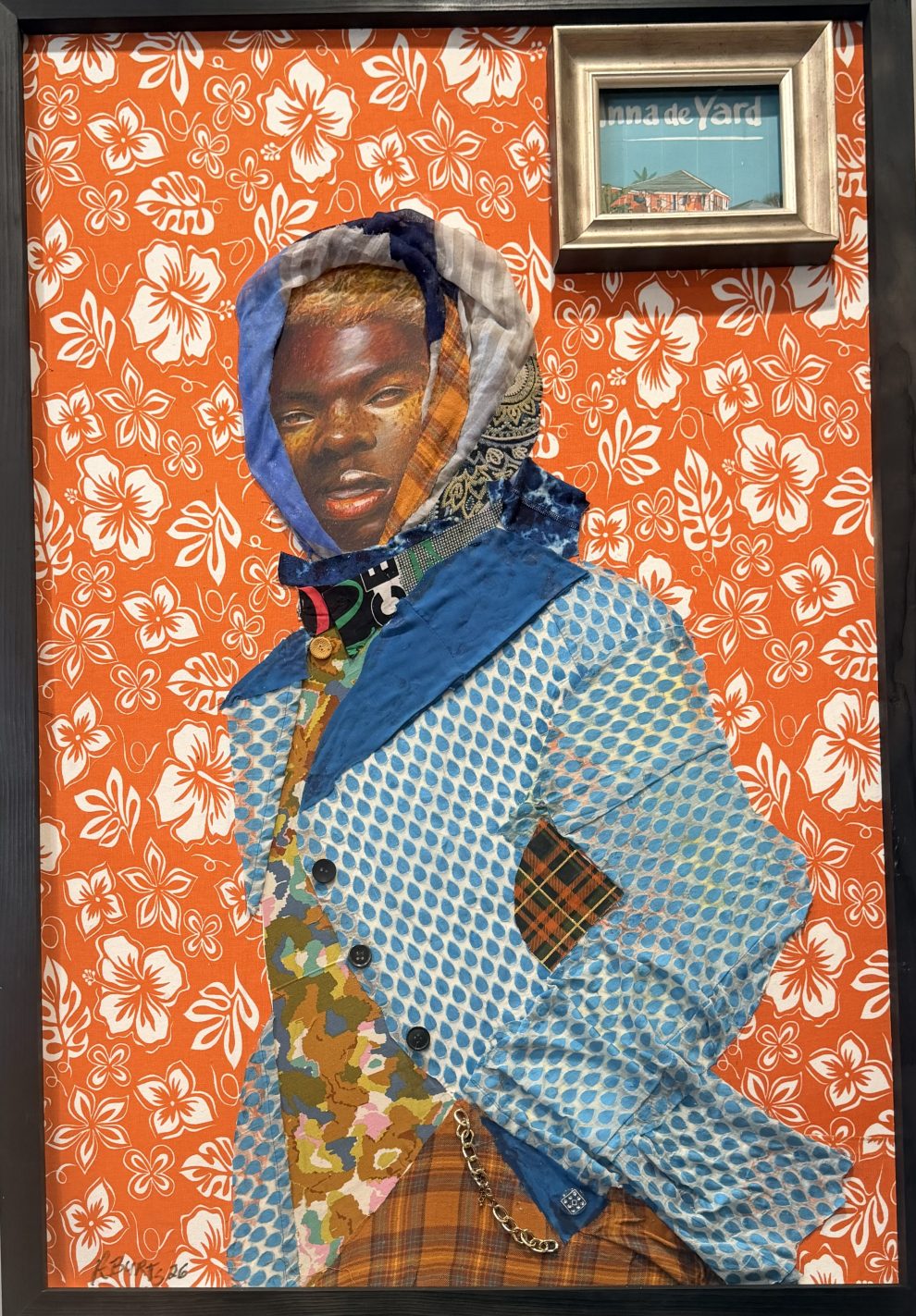
Through line, collage and an instinctive command of style, Al Burts transforms the American portrait into an intimate act of witness.
Clothing is rarely merely clothing in an Al Burts portrait. A jacket becomes geography, a hat assumes the authority of a crown and patterned cloth carries the hush of a grandmother’s house, the cultivated swagger of a Sunday afternoon and the stubborn, quietly glamorous fact of survival. Burts understands what fashion has always known, even when art history has occasionally pretended otherwise: presentation is not necessarily vanity. For people repeatedly denied control over how they are seen, style can become authorship, armor, memory and, rather deliciously, pleasure.
I have never had much patience for the critical superstition that beauty becomes intellectually suspect the moment it is pleasurable. Burts appears equally uninterested in such limitations. Working across ballpoint pen, colored pencil, charcoal, oil and collage, he creates portraits that move between exquisite draftsmanship and a gloriously tactile accumulation of material. His figures do not simply occupy space; they arrive carrying histories stitched, folded and layered across their bodies. Born in 1967 and shaped by Washington, D.C., and Alexandria, Virginia, Burts studied at the Duke Ellington School of the Arts, pursued fashion illustration at Virginia Commonwealth University and completed drawing studies at the Corcoran. He later worked at the National Gallery of Art, perhaps sharpening his awareness of how institutions determine whose faces are preserved and remembered. Drawing gives his subjects psychological gravity, while fashion supplies a language of silhouette, pattern and self-possession.
His portraiture gently refuses sentimentality and spectacle. Burts has addressed homelessness, migration, religion and the ordinary struggles of American life, often rendering people whose dignity is socially overlooked. In “Neglected Weed,” a series of large- scale portraits created with ballpoint pen, colored pencil and charcoal, he approached homelessness without surrendering tenderness or complexity. The title suggests a life dismissed as undesirable, something growing where society would rather not look, yet Burts chooses to look with patience and care.
He is not polishing hardship into a more palatable beauty. He is insisting, rather quietly, that beauty was never absent. Portraiture can so easily turn deprivation into visual consumption, asking the viewer to admire suffering from the safe distance of a gallery wall. Burts resists that transaction, allowing his subjects interiority, humor, fatigue, faith, vanity and an unmistakable command of themselves.
I remain somewhat suspicious of an art world that appears more comfortable inviting Black suffering into the room than Black pleasure. Burts, quite beautifully, refuses that bargain. He permits solemnity, eccentricity, weariness and fabulousness to occupy the same frame. His subjects are not sociological evidence; they are people, which should not be a radical proposition, although museums have occasionally behaved as though it were.
The title “The Fabric of Us,” used for one of Burts’s solo presentations, offers an apt thesis for the broader practice. Fabric is material, naturally, although it is also memory, status, inheritance, cultural code and the human desire to decide how one will enter the world. In Burts’ portraits, textiles feel alive, recording the private histories from which a self is made.
In “Many Threads,” a poised woman in oversized glasses, a head wrap and a coat assembled from colliding patterns becomes a walking archive. Her presentation is magnificent without becoming frivolous, while each surface contains a separate rhythm that contributes to a portrait of identity as layered rather than fixed. The Dude grants its silver-bearded subject a similarly luxurious excess of woven textures, florals and checks. There is wit in the work, certainly, yet also tenderness, and the abundance gathers around the figure like accumulated experience rather than overwhelming him.
His religious imagery deepens that inquiry. In “Sacred Commodity,” a child holds a branch of cotton against a delicately distressed ground. Cotton appears soft and nearly devotional, yet no American viewer can honestly approach it as a neutral botanical. The title binds sanctity to commerce and innocence to an economic history that treated Black life as property. Burts allows tenderness and indictment to coexist without permitting either to dilute the other.
Perhaps that is one of his most compelling abilities. He does not force complexity into dramatic opposition. Beauty and grief do not cancel one another, faith can contain doubt and clothing can be both protection and performance. History enters the portrait without consuming the person who stands before us.
Burts has said that he can create “pretty,” although he prefers conversational pieces. That distinction captures his achievement. The work is undeniably beautiful, sometimes extravagantly so, yet beauty functions as an opening rather than an escape. Color seduces the eye, texture slows it down and the figure, once encountered, gently refuses to be consumed quickly.
We live in a visual culture that asks faces to become content and identities to become instantly legible. Burts restores a more generous pace to looking, asking us to remain with someone long enough for our first assumptions to become inadequate. At a moment when the art world can confuse visibility with justice and fashion with frivolity, he offers a more humane proposition: To be seen beautifully is not to be softened but to be seen whole. In his hands, dignity is neither neutral nor quiet. It arrives dressed.
Al Burts’s work is on view at Gallery Guichard: galleryguichard.com. For more art and luxury, follow avalonashley.com.
By Avalon Ashley Bellos


