


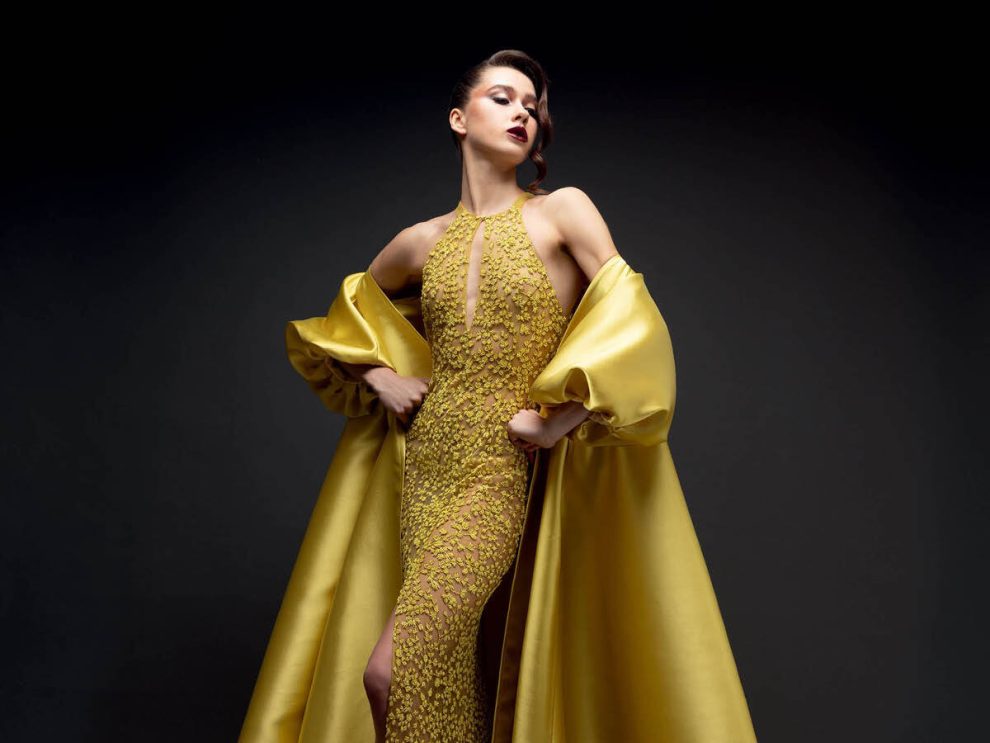
Music, dance, couture, philanthropy. Different stages, one premise: Spot the potential, then do the work.
Randi Rahm sees it first. The dress, yes, but also the woman in it, the way she moves, the room she enters, the impression she leaves once she’s gone. Most people with that kind of eye are content to admire it privately. Rahm is not most people. She wears her creative instinct on her sleeve.
Plenty of people have vision. Rahm has follow-through, which is rarer. She spots the potential early. Then she stays, sweating the details and trusting an instinct that keeps her a few steps ahead, until everyone else can see it too.
It started long before there was a label. Rahm’s fashion sense came from her grandmother, in a family that treated getting dressed as an art form in and of itself. She learned how pieces come together, how proportion rewrites a silhouette, how a person can announce herself before opening her mouth. Getting dressed was never just getting dressed. It was a series of decisions, each one a small act of self-disclosure. Rahm was reading them before she knew she was reading anything at all.
Making things came instinctively. Music, dance, drawing, design—each was a different door to the same place. Looking back, Rahm sees little difference between the child who gravitated toward making things and the designer she became. The medium changed; the inclination did not. Her training as a pianist and conductor gave those instincts discipline and taught her how a hundred small choices add up to one composition. She has always cared about the whole picture. She also knows it can hinge on one very small detail.
Couture was not the plan. By her own account, the business found her, beginning with a quilt she made for her newborn son that caught people’s attention and led, in time, to children’s clothing and then couture. Then came the part nobody puts on a mood board: learning to build the infrastructure around an instinct that had always been there. It was an education of its own, acquired through experience, mistakes and the daily demands of keeping a creative livelihood alive.
Behind the Madison Avenue showroom, in the back of the atelier, lies the heart of the house. There, a devoted team of seamstresses, patternmakers, cutters and beaders brings each design to life. This is the living work of couture: skilled people responding to one garment and the one person who will wear it. Every piece is built one stitch, one bead, one seam at a time. Everything is made in-house. Everything passes through human hands, which makes the atelier one of the few places where couture is still made the way couture is supposed to be made. A fitting reveals what the drawing couldn’t, and it is here, in the hands of her artisans, that a sketch stops being an idea and becomes a one-of-a-kind heirloom. There is nothing accidental about something that looks effortless.
Preserving that legacy of technique and precision has never meant standing still. The atelier is the foundation; the future is where her curiosity keeps wandering.
Randi Rahm is, by most measures, early. Her designs have a way of arriving two or three years before the rest of the industry catches up. The clearest proof is the convertible bridal gown, which she traces to 1989. By adding or removing sections, such as a detachable skirt, train or overlay, a single gown could transform into an entirely different look. Formal and grand for the ceremony, something else entirely for the reception, and never dull about it. The ceremony and the reception are two very different events, and the dress need not pretend otherwise. It combined the things Rahm cares about most: elegance, usefulness, drama and the freedom to have options. It was practical and theatrical, which is to say very Randi.
Her curiosity extends to technology, too. Rahm was among the first designers to bring artificial intelligence into her campaigns, creating futuristic AI-generated landscapes and placing her models, dressed in her real gowns, within them. The result merges the handmade and the imagined: couture constructed stitch by stitch in a New York atelier, presented in worlds that exist nowhere else.
That instinct to go first is also how she built her name. With no conglomerate behind the label, every bit of its visibility had to be won. Rahm has been at the helm from the start, conducting every part of it herself, from photoshoots and social media to the red carpet. She never waited to be discovered; she made sure she was seen. Few moments were as dazzling as the 2004 Academy Awards, when Maria Menounos walked the red carpet in Rahm’s $2.5 million diamond gown, a dress that turned couture into headline news. It was far from the last. Beyoncé wore Rahm to perform at the White House. Sally Field chose her to present at the Academy Awards. Carrie Underwood took the stage in Rahm at the Country Music Awards, Miranda Lambert at the American Music Awards and Jennifer Hudson wore her for a 2011 feature in Ebony. In 2005, Mariah Carey wore Randi Rahm in not one but two music videos: a custom gown in “It’s Like That,” and Randi Rahm’s Twisty gown in “We Belong Together.” Her designs also graced the holiday windows of Bergdorf Goodman and Saks Fifth Avenue. Add the countless stars who have worn her at the Tonys, and the list grows almost too long to count. None of it is an accident. It is the result of years of tireless work and of a designer who never stopped showing up.
Not every milestone was the product of pursuit. For years, the “Bachelor” franchise offered a different kind of endorsement. Before each rose ceremony on “The Bachelor” and “The Bachelorette,” the women would enter a warehouse lined with thousands of gowns from designers of every stripe, free to choose whatever they wished. Season after season, they kept reaching for Rahm’s. No campaign could have arranged it; the dresses simply had to earn their place on the rack and on the women who wore them. To this day, many of those women remain part of Rahm’s life. What began with a dress became a friendship.
Rahm has never treated presentation as an afterthought. For Billy Porter’s 2019 Golden Globes appearance, she designed an embroidered suit and a pink-lined cape that made movement the point. The look took six months to prepare. It gave a performer something to perform in, and its detail and scale became part of the statement he made. It was fashion that understood its audience, its setting, and the person at its center.
The look’s final setting was even more commanding. The ensemble was chosen for “Fashioning Masculinities: The Art of Menswear” at London’s Victoria and Albert Museum. Rahm found her creation in its own glass case, among work by masters she had long admired. She describes the experience as surreal: her own work, standing in the company of the artists who had shaped her eye.
Museums, it turns out, were becoming something of a habit. The late Joan Rivers was not only a close friend of Rahm’s but an avid wearer of her designs. When Madame Tussauds Hollywood created its wax figure of Rivers, it was Rahm who dressed her.
The friendship came naturally. Rivers understood glamour as both pleasure and performance. She loved to look beautiful, and she loved the world to notice. Rahm’s designs gave her both. One dress in particular became such a favorite that, as Rahm tells it, the only way to get it back would have been to go to Joan’s house and take it off her back. Now Rivers’ likeness wears Rahm’s work for good. As Rahm puts it, the two of them are together in a museum for “eternity.” For a woman who made a career of judging what everyone else wore, there could hardly be a higher compliment.
Rahm’s ties to the performing arts run deeper than who wears her clothes. She started in music and movement, and has spent years paying it forward, beginning with The Children’s Storefront, the Harlem school where she helped introduce children to the arts. The lesson reached beyond the disciplines. The children were also learning to communicate, build relationships and work through conflict. The arts, Rahm saw, could teach a person how to engage with the world.
The same conviction drives her support of the NYC Dance Alliance Foundation, which champions dance education and helps young dancers afford serious training through high school and college scholarships. For Rahm, though, the scholarship is only the beginning. What matters just as much is what comes after: the moment a dancer steps out of the studio and has to build a working life. Talent may be developed alone but a career rarely is. Every artist needs people in their corner, those who share what they know, open a door or recognize an opportunity before it passes. Rahm has made a point of being one of them.
Dance, for Rahm, was never only a cause. It had a face. Her friendship with the late Chita Rivera, the Broadway legend she dressed on many occasions, including the Tony Awards, drew her ever deeper into the world of dance. Chita was honest, humble and endlessly inclusive, and for Rahm, an enduring inspiration. Today, Rahm sits on the board of the NYC Dance Alliance Foundation, which keeps Chita’s legacy alive through its Triple Threat Award, a fitting tribute to a performer who could sing, dance and act like few others.
Most designers present their work during Fashion Week. Rahm built her own. Couture for a Cause is her runway show, and it comes with a purpose the official calendar doesn’t require. Each presentation is tied to a charitable cause. The gowns get their moment on the runway, and so does the cause.
The impulse is consistent. She notices something worth developing and gets involved in what it will take. Sometimes she offers a design, a place for people to gather, or an introduction between two people who ought to know each other. Sometimes she offers the perspective of someone who has already been through the hard part. The form changes. The willingness doesn’t.
Rahm has never learned to switch it off. The instinct that found her in music, couture and imagined landscapes keeps moving, and this time it has led her to jewelry. Resinate, her colorful new collection, is the next picture only she could see. The name is a fitting play on words: pieces crafted in resin, designed to resonate. It is what her instinct has been doing all along, finding what will strike a chord and staying with it until everyone else hears it too. So keep an eye on Resinate, and on whatever Randi Rahm dreams up next. The rest of the world tends to arrive late. By the time it does, she is usually already looking at something else.


