


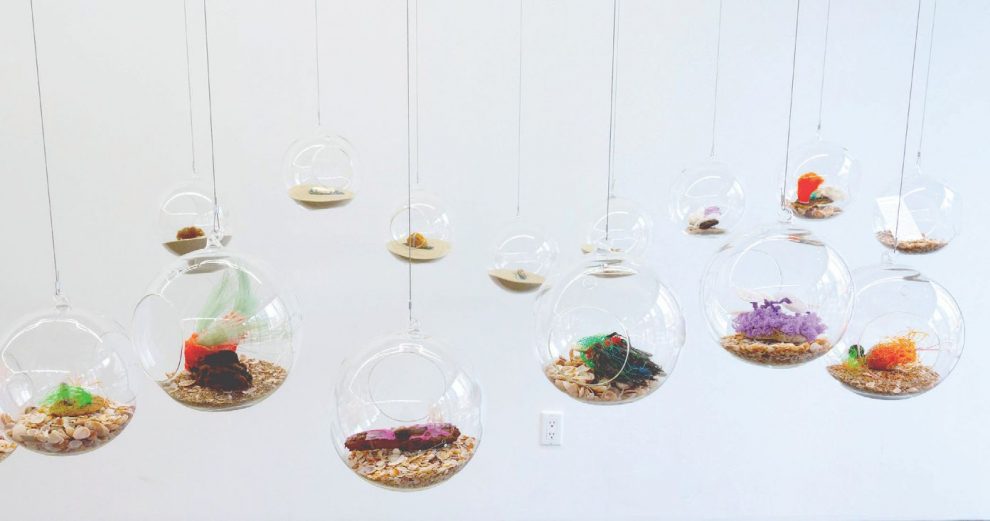
the Bezalel Academy of Arts & Design in Jerusalem explores using natural materials as a base for creation

Exploring the meaning and identity of natural materials from bacterial cellulose and fungus to cultured pearls and volcanic rock as a base for creation, “MaterialNess” investigates the effects and ramifications, positive and negative, of the earth’s natural resources and the process on the environment, on the social-consumer level and the physical-environmental level. The installation features jewelry, vases and one-of-a-kind works by artists representing the Bezalel Academy, Israel’s oldest art institution. It includes nine projects, totaling 60 original designs based on natural earth elements as they grow and transform, including some “living” pieces.
“The exhibition considers the complex triangular relationship between material, process and environment and tries to shed light on works that, at their core, find a tension between earth, growth and source of the material and process, product and effects,” explained Udi Urman, executive director, Friends of Bezalel.
“In an age when most things seem to be accessible, fast and replaceable, the exhibit presents projects that focus on the process itself, its duration, the raw materials used and, alternatively, the environmental results of the processes that occur as p art of and/or following the production. Be zalel Academy is a pioneer and innovative force in arts and design. The exhibition offers a unique way to look at the materials we use in design while raising questions about sustainability, climate and other social issues.”
Some of the projects presented investigate new ways of using, processing, or growing material; others use materials to criticize how we, as a society, relate to the resources around us.
“One artist searched nature to find a unique element in which her intervention would be limited but would still give it a new shape, choosing the fungus Auricularia auricula-judae with the awareness that the objects in this project will fall apart and new objects will be born,” said curator Arial Lavian. “Another project explores the environmental damage and pollution that occurs behind the scenes of the fashion industry through a series of stools made of textiles and iron. The fabrics used were leftovers gathered from fashion houses and sewing workshops.”
“MaterialNess” features works designed by lecturers, graduates and students from various departments of the Bezalel Academy of Arts and Design in Jerusalem. Artists featured include Adi Farber, Anaelle AA, Maavan Fima, Natalie Feldesman, Arial Lavian and Nitzotz Saranga, with Lavian also serving as curator.

Symbiosis by Maayan Fima
“‘This project began while observing lichens in the way they maintain symbiosis with trees. It made me think about symbiosis and how we, as consumers and as a society, do just the opposite by using plastic. This project observes two contradictions — plastic and nature. Plastic is an almost non-biodegradable material and therefore has a huge impact on nature. How can we deal with the amount of plastic that already exists? How can we produce less waste or no waste at all? The goal is to believe that we can make a difference and, above all, to ask how humankind can find symbiosis with nature.”

New Fossils by Adi Farber
“This set of jewelry explores the existing tension between growth and dissolution. The broken strings of pearl beads were soaked in kombucha solution and became new objects. Kombucha fungus (bacterial cellulose) is a living organism; it grew like skin on the surface, spread out, enveloped and sometimes peeled the pearl’s surface. The new substance’s instability and constantly changing nature reacts to its environment expresses the new object’s temporality and transience. They are ephemeral.”

Multiplication by Anaelle AA
“Over time, the objects in this project will fall apart and new objects will be born. I searched in nature to find a unique element where my intervention with the environment would be limited, where I could still give an element a new shape. Intuitively, I chose Auricularia auriclua-judae (fungus). While researching, I marveled at the new materials in my hands. I focused on its features and tried to understand them while trying to control the element’s shape.”

Obsessidian by Nitzoz Saranga
“Volcanic eruption: a vast force of nature from the depths of the Earth. Splashing lava crystallizing in thin air or slowly cooling through a sinister flux. The project, “Obsessidian,” as the name indicates, was born from my long-time obsession with stones and volcanic rocks. This led to a rethinking of lava as a raw material and its intervention in volcanic phenomena and in places that have been natural thus far. This project considers the transformation of lava to rock and then to volcanic gas. It shifts between natural and unnatural, local and global, precise techniques and uncontrolled and random phenomena.”

25 Nature Films by Natalie Feldesman
“This video installation is a collage created from archival materials. My motivation for using found footage originates from living in an era of information overload. In this piece, I wish to regurgitate the images into a new meaning. This meaning may simply be that there’s no meaning at all, only the desire to further understand ourselves through the images which surround us. The materials meet and create a new scene, and through their broken relationships, they portray a new, semi-abstract image. The images root from my preoccupation with nature’s history and the way man represents the natural world through moving images. We won’t see humans in the video, only their gaze, raising questions of humankind’s domination over the natural as the distance grows between humans and their own nature.”


