


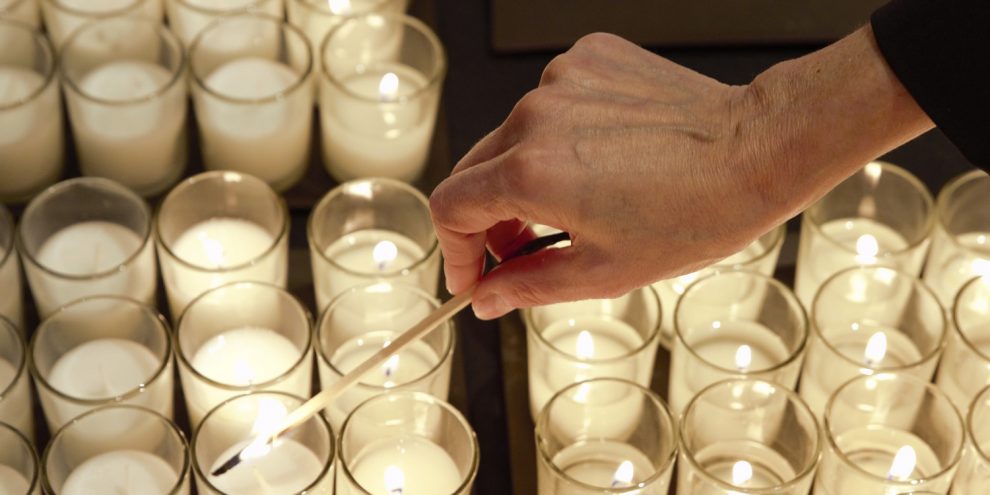
This April, the Museum of Jewish Heritage – A Living Memorial to the Holocaust will provide an array of programs, allowing audiences to connect with the museum at home and deepen their understanding of the Holocaust through book talks, conversations with Holocaust survivors, lectures and more.
In addition to online programming, the museum still is open to visitors three days per week: Wednesdays, Thursdays and Sundays with limited hours from 10 a.m. to 5 p.m. General admission, timed-entry tickets purchased online in advance allow access to all museum galleries. On the other days, the museum deep cleans all public spaces.
April Events
Remembering Olga Lengyel and “Five Chimneys”
Tuesday, April 6 at 4 p.m. EDT
In 1944, Hungarian physician’s assistant Olga Lengyel was deported to Auschwitz along with her parents, husband and two sons. She was put to work in the Auschwitz infirmary, where she also secretly toiled for a French underground cell, helping to demolish a crematory oven. At the end of the war, she was the only member of her family to survive. Lengyel made her way to New York. In 1946, she published “Five Chimneys: A Woman Survivor’s True Story of Auschwitz,” which became one of the earliest testimonies to depict the barbarism of the Nazis and inspired William Styron’s award-winning novel “Sophie’s Choice.” Twenty years after Lengyel’s death in April 2001, join the Museum and The Olga Lengyel Institute for a program exploring her remarkable life and legacy. The program will be moderated by Sara R. Horowitz, professor at York University and an expert on women and the Holocaust, and will feature David A. Field, chairman of the Institute’s Board of Directors; Nancy Fisher, museum trustee who conducted a four-hour interview with Lengyel for the USC Shoah Foundation and Robert Jan van Pelt, scholar and chief curator of “Auschwitz. Not long ago. Not far away.”
Stories Survive: Mark Schonwetter
Thursday, April 8 at 2 p.m. EDT
Mark Schonwetter was a young child in Brzostek, Poland when Germany invaded, and his family was forced out of their home. After his father was taken by the Gestapo, Schonwetter fled along with his mother and sister. They spent time in a nearby ghetto and then went into hiding in the Polish countryside, where they remained for three years. By the end of the war, Schonwetter was one of only a few surviving Jews from Brzostek. Schonwetter emigrated to the United States in 1961 and found work in a jewelry factory. He ultimately purchased another jewelry company and remained in the jewelry business until he retired in 2018. Schonwetter and his daughter Ann Arnold, author of “Together: A Journey for Survival,” share his story of courage and compassion in this Stories Survive program.
Annual Gathering of Remembrance
Sunday, April 11 at 2 p.m. EDT
Every year, at the Annual Gathering of Remembrance, the museum brings thousands of New Yorkers together to say with one collective voice, “We will never forget.” Delivered by a city with one of the world’s largest communities of Holocaust survivors, the tribute has a power that echoes across generations. This year’s gathering will be held virtually in observance of Yom HaShoah (Holocaust Remembrance Day). The program will feature music, remarks from Holocaust survivors, young people and public figures, as well as a candle-lighting ceremony.
“The Light of Days” Book Talk with Judy Batalion And Molly Crabapple
Tuesday, April 13 at 2 p.m. EDT
After witnessing the brutal murder of their families and neighbors and the violent destruction of their communities, a cadre of Jewish women in Poland ― some still in their teens ― helped transform Jewish youth groups into resistance cells to fight the Nazis. With courage, guile and nerves of steel, these “ghetto girls” paid off Gestapo guards, hid revolvers in loaves of bread and jars of marmalade and helped build systems of underground bunkers. In “The Light of Days: The Untold Story of Women Resistance Fighters in Hitler’s Ghettos,” Judy Batalion — granddaughter of Holocaust survivors and author of “White Walls” — brings these women’s stories to light. The book, scheduled for release in April 2021 and already optioned by Steven Spielberg for a major motion picture, is an unforgettable true tale of bravery, friendship and survival. Artist, author and journalist Molly Crabapple joins Batalion for a conversation about “The Light of Days.”
A Conversation with Helen Epstein About the Second Generation
Thursday, April 15 at 7 p.m. EDT
In 1979, Helen Epstein published “Children of the Holocaust,” one of the first books to examine the intergenerational transmission of trauma from Holocaust survivors to their children. In the four decades since its publication, Epstein has published 11 additional books (including “Franci’s War,” a memoir of her mother’s life, in 2020) and served as a leading voice among descendants of survivors. She is also active in Holocaust memorialization work in the Czech Republic, where her family is from. As Holocaust survivors get older and their descendants assume the mantle of Holocaust memory, the issues raised by Epstein’s work are taking on new and important meanings. Ellen Bachner Greenberg, founder of Descendants of Holocaust Survivors (2G Greater New York), joins Epstein for a conversation about Epstein’s life, legacy and the questions she faces today.
Kwibuka and Yom HaShoah: a Joint Remembrance
Sunday, April 18 at 2 p.m. EDT
Survivors of the Holocaust and the 1994 genocide against the Tutsi in Rwanda come together to commemorate Kwibuka 27 and Yom HaShoah. This event is presented in partnership between the Agahozo-Shalom Youth Village, the Museum of Jewish Heritage and the Genocide Survivors Foundation.
Painting the Holocaust: Remembering Alfred Kantor And His Sketchbook
Tuesday, April 20 at 4 p.m. EDT
In December 1941, Alfred Kantor arrived at the Terezin Ghetto. An 18 year old artist from Prague with one year of study under his belt, Kantor began to draw scenes around him.
“My commitment to drawing came out of a deep instinct of self-preservation,” he later wrote, “And undoubtedly helped me to deny the unimaginable horrors of that time.”
Kantor continued drawing and painting at night after he was deported to Auschwitz and to Schwarzheide and then again after the war in the Deggendorf Displaced Persons Camp. The hundreds of sketches and watercolors he produced between 1941 and 1947 constitute one of the most prolific artistic records of the Holocaust. His sketchbook is on display at the museum, and several of his works are in “Rendering Witness: Holocaust-Era Art as Testimony.” In this virtual program, the Museum celebrates Kantor’s remarkable life and legacy with his daughter Monica Churchill, filmmaker Zuzana Justman and Ori Z. Soltes, professor at Georgetown University and former director the B’nai B’rith Klutznick National Jewish Museum.
Stories Survive: Manfred Ohrenstein
Wednesday, April 21 at 2 p.m. EDT
Manfred Ohrenstein was born in Mannheim, Germany in 1925. He grew up under increasingly restrictive Nazi rules, holding his Bar Mitzvah at age 13 on the precipice of the Holocaust. In November 1938, less than a week before Kristallnacht, Ohrenstein and his family escaped Germany, made their way to London and found refuge in New York City. Ohrenstein attended high school, college and law school in his new home, shedding his German accent along the way and practicing public speaking as a soapbox orator on behalf of Zionism. Ohrenstein became a prominent civic leader in New York, representing Manhattan from 1961 to 1994 in the New York State Senate and serving as the Minority Leader of the State Senate for more than half of his tenure. He co-founded the museum in the 1980s and still serves as a vice chairman of its board of trustees. Jack Kliger, Museum president and CEO, joins Ohrenstein for this Stories Survive program exploring Ohrenstein’s story of escape and leadership.
Exploring Neuroscience and the Legacy of The Holocaust
Thursday, April 22 at 2 p.m. EDT
Neuroscientist Dr. Daniela Schiller, who leads the Affective Neuroscience Lab at the Mount Sinai School of Medicine, has spent years exploring “reconsolidation” — the biological process of rewriting painful memories. Her groundbreaking work is shaped by her personal experiences with her elderly father in Israel, who remains haunted by the Holocaust decades after he survived it. Filmmaker Liron Unreich has spent years exploring multigenerational trauma through a different lens. Like Schiller, his work is a personal mission informed by his own grandfather’s legacy as a Holocaust survivor. The two of them have joined forces with producer Roy Wol to create the upcoming documentary “The Ripple Project ONE,” which profiles five creative individuals working through the enduring trauma of the Holocaust. Schiller, Unreich, and Wol explore Schiller’s personal story, the journeys behind the film and the dynamic nature of traumatic emotional memories. Program attendees will also receive a private screening link to view a 22-minute film vignette of Daniela’s story.
“The Ravine” Book Talk with Wendy Lower and Paul Salmons
Tuesday, April 27 at 2 p.m. EDT
In 2009, Dr. Wendy Lower, the acclaimed author of Hitler’s Furies and chair of the United States Holocaust Memorial Museum’s Academic Council, was shown a photograph just brought to the Museum. The image — a rare “action shot” documenting the horrific final moment of a family’s murder — drove her to conduct years of forensic and archival detective work in Ukraine, Germany, Slovakia, Israel and the United States about the Nazis’ open-air massacres in eastern Europe and the role of the family unit in Nazi ideology. In her new book “The Ravine: A Family, a Photograph, a Holocaust Massacre Revealed,” Lower explores the exceptional image and the new understandings it has unlocked about the Holocaust. Paul Salmons, Holocaust education specialist and curator of “Auschwitz. Not long ago. Not far away.” joins Lower for a book talk on her research for The Ravine.
An American Pogrom: Reckoning with the 1921 Tulsa Race Massacre
Thursday, April 29 at 7 p.m. EDT
One hundred years ago, on May 31 and June 1, 1921, white mobs in Tulsa, Oklahoma attacked the city’s Black residents and businesses in one of the worst incidents of racial violence in American history. They killed hundreds of people and destroyed 35 square blocks in the city’s Greenwood District, also called “Black Wall Street,” which had been the wealthiest Black community in the United States. This racist massacre on American soil was similar in many ways to the pogroms experienced by eastern European Jews, in which violent antisemitic mobs attacked Jewish people, homes and businesses. But the 1921 Tulsa race massacre was a taboo topic for decades in the United States, including among some American Jews. This groundbreaking program explores Tulsa and its legacy, on the eve of the massacre’s centennial. Judy Woodruff, anchor and managing editor of the PBS NewsHour, will moderate a discussion featuring Dr. Hasia Diner, professor at New York University and author (“In the Almost Promised Land: American Jews and Blacks, 1915-1935”); Hannibal Johnson, author (“Black Wall Street: From Riot to Renaissance in Tulsa’s Historic Greenwood District”) and chair of the Education Committee for Tulsa’s Centennial Commission and Jonathan Silvers, documentary filmmaker and founder of Saybrook Productions which is directing “Tulsa: The Fire and the Forgotten,” a centennial exploration of the 1921 race massacre which will premiere on PBS on May 31.


