


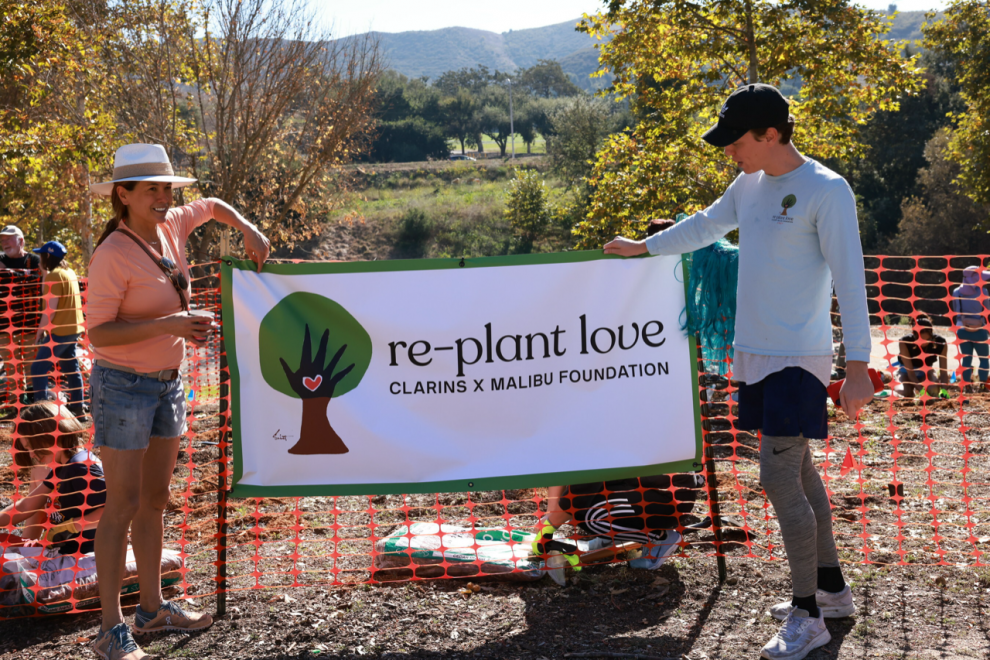
Clarins, in partnership with The Malibu Foundation, joins forces again for the fourth annual community Replant Love event with the mission to plant the first micro forest in the Santa Monica Mountains to restore the local biodiversity lost in the Woosley Fire in 2018. Supported by California Climate Action Corps, more than 150 volunteers planted at De Anza Park to reach the Clarins x Malibu Foundation’s goal.
With already over 21,000 trees planted over the four years (a record in the Santa Monica Mountains), this year’s edition pushes the sustainability vision with a micro forest inspired by the Miyawaki method, which mimics nature, increasing survivability, cooperation, and competition, leading to faster growing plants, increased biodiversity, and less dependence on water. The micro forest planted included a total of 500 curated, new plants and is the second in Los Angeles County. It also serves as a seed bank, leading to additional local micro forests to be planted, including three funded by Clarins.
Benefits of a micro forest:
- Remediate soil
- Conserve water
- Improved carbon sequestration
- Increased biodiversity, including native insects and animals moving back into the forest
- Supports the food web, from providing appropriate food for native species
- Becomes self-managing after 2 years
- Provides shade and reduces heat in the area
- Refuge for wildlife
Replant Love has built an engaged community over the past four years, including many influential voices, who season after season help spread the word —including friend of the foundation Orlando Bloom, and locally based personalities Indy Srinath, Paris Brosnan, Daniela Lawson Osorio, Talia Jackson, Armani Jackson, Holly Ramsay, Jenny Watwood, Mariama Diallo, Alex Lee Aillon, Ari Fournier, and Renee Murden.
De Anza Park
Ignited on November 8, 2018, the Woolsey Fire destroyed 88% of the Santa Monica Mountains, impacting nearly 97,000 acres, and devastated the cities and towns in the region, including Calabasas. Since then, the area became overrun with over 300 non-native, highly flammable, invasive plant species that are pushing out native vegetation.


